
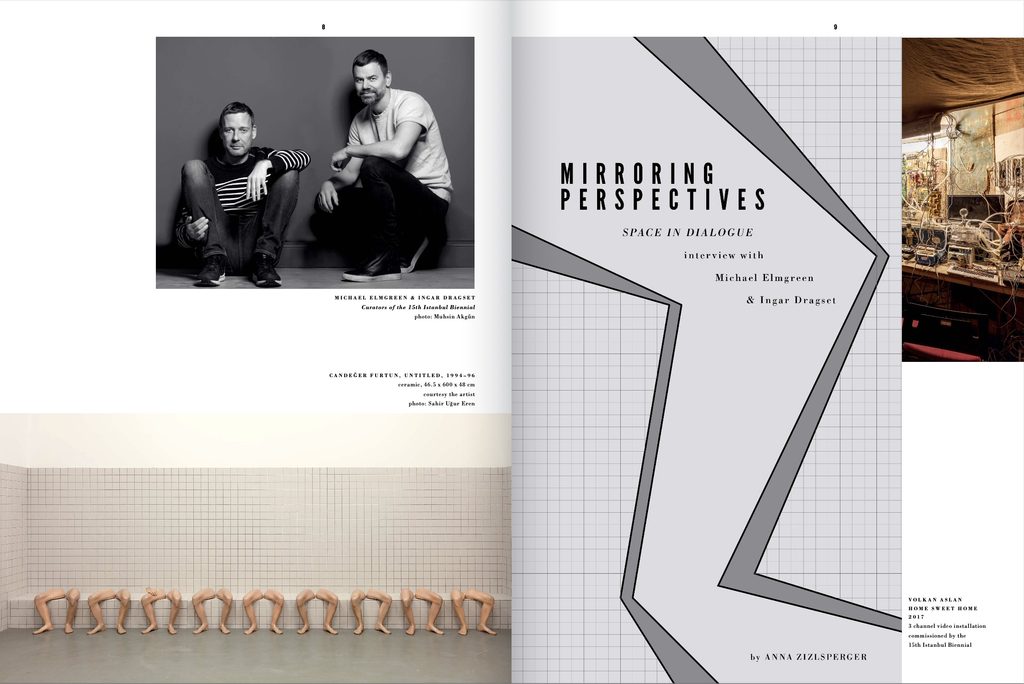
Originally published in exhibist Print Issue 13 (September 2017).
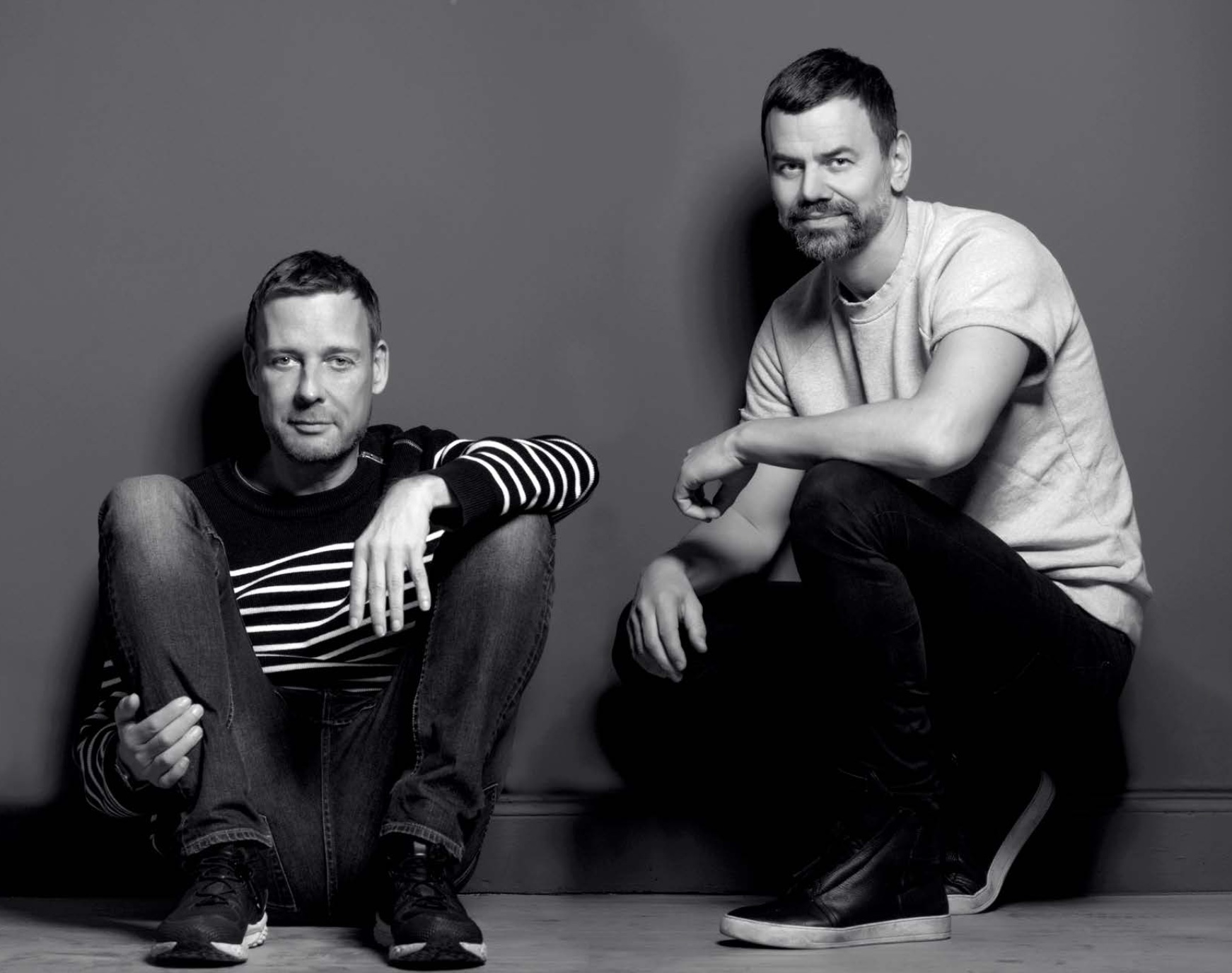
An interview with Michael Elmgreen and Ingar Dragset, curators of the 15th Istanbul Biennial, by Anna Zizlsperger.
Can you talk a bit about your experiences in relation to this biennial project? Which aspects did you enjoy most?
ID: It is very exciting to see how this kind of project can influence your own process. We learned a lot from traveling to other countries like South America, South Africa and Asia and from talking to older artists everywhere, also in Turkey. We even met people who we really admired for years. Fred Wilson for instance or Mark Dion. But it was also great to meet the younger generations. We generally don’t have the chance to talk to them that much because we are not teaching. So it has also been a chance to hear what’s going on in their minds and how they are dealing with things.
ME: It was also very exciting to enable artists to develop new work. Out of the 56 contributions, 30 of them are new commissions.
ID: Yes, it has been great to be part of this process as well. It was really extremely rewarding for us.
This is the first major exhibition you curated. Can you tell us a bit about your approach? Did you consult curator friends?
ID: We never had this idea of artists vs. curators. I mean when we started out doing art in Copenhagen in the mid-90s, there was no possibility to show your work unless you did it yourself, so there were lots of artist-run galleries. We would make exhibitions ourselves, as well as performance festivals and bigger exhibitions. You would invite your friends but you would not consider yourself a curator in that sense. And the few curators that were around were also part of the scene and we did these things together.
ME: It gives us a lot of freedom being artists curating this biennial because we are not going to curate another biennial.
You have made this statement before, are you sure and why is that?
ME: Yes! It takes a lot of time. And artists are natural born egomaniacs, so of course our self-obsession has suffered tremendously in the past one and a half years. We had to be in the service of others instead, which was good. One and a half years is kind of military service and we have done that now and we are not going to do it again…
It seems that you have been getting a lot of questions regarding why you are curating the biennial in Turkey at the moment. There were even calls for a boycott. What is your position on this?
ME: There are good reasons for having critical approaches, which is important. But it is very sad that you don’t hear about other things. We live in Germany, and I don’t think Germans would like it if they were only judged by their government and nothing else were reported, as this is really not doing the people of Turkey any favours. It is really disastrous for all the progressive forces in the country that you don’t hear all the things that are happening here in progressive ways. You only hear the negative stories. And therefore people easily come to these very black-and-white conclusions about calling for a cultural boycott. Should we not make shows in Dresden because AfD has such a high percentage of votes? And who would a cultural boycott harm? What about the €37 billion in annual bilateral trade Germany has with Turkey? Would you like to stop that? Because then you would feel it in your daily economy. No, it’s better to cancel an exhibition, that would affect the government in Turkey for sure! German companies are so deeply involved and dependent on cheap labour in Turkey, so that’s why they can’t really speak about anything even if they really wanted to. Because then it would cost a hell of a lot of money. Instead it is much easier to say “we shouldn’t do this exhibition”.
Are there any new positions that you discovered during this biennial project that you would like to tell us about?
ID: There were several artists that had positions that were new to us. The first one that comes to mind is Lungiswa Gqunta. We saw her graduation show in Cape Town. You probably won’t have heard about her because she is very young. And she is from a totally new generation of South Africans, who sort of grew up without apartheid. So she is sort of the first generation who was born long enough after it to be not just grateful for it to be over but also having actually detected some more things that need to change. She is also part of those groups that protested at universities there last autumn, because racism is still a huge problem there. I mean it is practically still segregated in many places, not just in Cape Town.
Then there is Candeğer Furtun, who is from Turkey. She was also a new discovery for us. She is 82 and has had her studio in Istanbul since 1964. She studied abroad, in America and England. She is amazing and she hasn’t really shown very much, so we were very excited for her to be a part of the biennial.
ME: The work we are showing in the biennial is one she made many years ago but it is so relevant today. It is these male legs sitting there in the ‘man-spread’ which is being debated everywhere right now. So it looks like a young artist referring to the media talking about how you sit on the subway if you are too macho. It is actually prohibited in the New York subways now to sit that way. She is kind of a fantastic re-discovery because she is an artist whose work has interacted with feminist issues for many years. People had stopped really talking about her, so it is a great thing to involve her.
Did you also check out the young artist scene in Istanbul?
ME: Yes of course, we did that a lot. For example with Volkan Aslan, who is a very young artist, we were able to give him the opportunity to work on a very ambitious three-channel video project. It is one of his biggest projects so far. We have seen a lot of artists’ work and ultimately included 10 artists from Turkey in the final 56. We didn’t want to take the usual suspects though and really focused on newer positions.
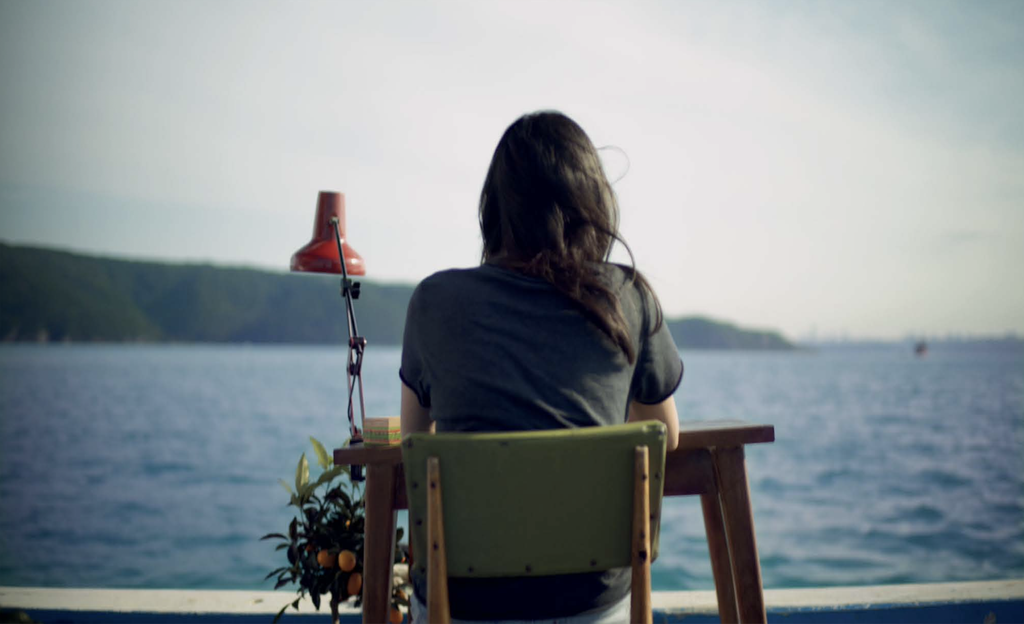
HOME SWEET HOME 2017
3 channel video installation commissioned by the
15th Istanbul Biennial
Can you talk a bit about your international artist research?
ID: We travelled a lot but there is only so much time and resources you have at your disposal to travel. I mean one of us went to America and Asia and the other one went to Africa and South America, while both of us went around Europe. So between the two of us, we covered quite a bit of ground in an old school way, going to studio visits. And of course in some of these places we asked artists and curator colleagues if they would propose artists that we should see as well. We have been in dialogue with people everywhere.
And then today of course, there are things you discover online. I mean there is the occasional Instagram post that makes you really curious. And you dig further.
ME: Another advantage of being artists curating the biennial is that we have allowed ourselves to be personal. We are not making a ‘zeitgeist’ exhibition. We are not trying to map a tendency or to reflect a certain kind of working method. We have simply been curating this exhibition from our personal perspectives. We decided what we liked and thought was great in relation to the theme.
With the biennial opening soon, what is your overall feeling about the whole experience?
ID: We are both very experienced in doing models and 3D renderings of spaces, so in that sense I feel we are very well prepared. But of course it is extremely exciting right now to see all the work arriving. Of course we are very curious to see how everything will work together.
ME: All the discussions and the dialogues and the process of shaping narratives and putting new perspectives on different topics have been very rewarding. But as artists we are also trained in the visual side of an exhibition. I think we have an advantage in that we know exactly how things look if you place them in a certain way in a space and that’s been quite helpful. We are not only textual, you know, but quite physical and visual in the way we put together exhibitions.
What about writings on the theme of the biennial. What can we expect in terms of publishing?
ID: We actually made a whole reading list which will be published on the biennial website soon. It is a selection of writings that combines things that have been informative for us for many years alongside several new things. It contains writings by Georges Perec, for example, who’s pretty crazy. Experimental writing has been quite formative for us.
ME: There are a lot of series on the notion of home on our list, and how living habits have been changing over the past few decades in different parts of the world.
ID: Many of those writings also deal with how migration in a more general sense – not only migration in the sense of the migration crisis – affects these habits. I mean you are German and live here in Istanbul and we live in Berlin and most of the artists in the biennial live somewhere else than where they were born. Most of them have moved. I am really into Sara Ahmed’s theories on migration and how that influences us and our psychologies or perceptions of home.
There will be two publications accompanying our biennial project. One of them is called ‘exhibition’ and it is both the biennial guide book and an exhibition catalogue. There are short texts on every artist written by Pablo Larios, a young writer born in Honduras, raised in the US and living in Berlin. And then we have a text by Kaelen Wilson-Goldie, who is based in Beirut and has also been living in other places in the Middle East. She has seen every Istanbul Biennial before and reviewed all of them. So it was new for her to work with us and be on the other side this time, mediating the exhibition with our thoughts in a way and contextualising it within the region. We wrote the introduction ourselves for that book. We also made a story book, which is something we have done once before, where we invited participating artists but also artist friends, curators, academics, people we know and people who are close to the biennial, to write a story in relation to the title ‘a good neighbour’ and it was really interesting to see what people had to say.
ME: We received contributions in very different formats. Some are poems, some are fictional takes, some are personal, some theoretical, it is a huge mix. We have 69 contributions in total.
That’s almost a project on its own!
ID: In a way yes. It was really touching how responsive people were to this invitation. And we also like the fact that through these publications the exhibition will live on into the future. Of course there is a website, but it’s very different to have an object, a book.
With space being a prevalent concept in your work, I wanted to ask you about the spaces you chose for the biennial and how you chose them? Did you incorporate the context of the venues in your exhibition concept?
ID: One of the venues is a bit far, but all the other five are very close together, so that you walk in between them and get this neighbourhood feeling when you visit the different venues. In one of our chosen venues, the Galata Greek Primary School, we showed our own work at the 13th Istanbul Biennial in 2013. It was a work called Istanbul Diaries. We really liked the space, it is very atmospheric. And of course as a school building it has this interesting legacy as a space of knowledge and about imagining how we pass on knowledge. Something about both the past and the future somehow. The school also has many interesting spaces like differently sized classrooms and also the hallways, the stairway landings, the stairs themselves, the mysterious attic space and the ballroom in the middle. The venue gives the artists a lot of different possibilities for different kinds of work. Some have made work especially for the venues. In the ballroom for instance there will be kind of a durational performance work by Pedro Gómez-Egaña. And upstairs in the attic there will be a sort of maze especially constructed by Leander Schönweger according to the carrying structure that is there. We really wanted to use the whole school.
And Istanbul Modern, it’s just such a clear space, one big open room. Being a former industrial space, it is simply very easy to fit certain types of work there and gives the possibility to show work that needs museum conditions. And now with the whole construction activity going on around Istanbul Modern it is kind of crazy when you enter the area around the museum, it is as if you walk on a building site. So we also wanted to use that as a sort of starting point for the show there. A lot of artwork there is kind of dealing with urban development in one way or another. Also displacement for that sake. Something goes away and something new comes.
ME: Many of the works at Pera Museum are aware of being in a museum that has a historic collection. They are referring to this old-school way of collecting and writing history through artefacts. On the other hand, at Galata Greek Primary School for example, Mark Dion has worked with artists and students from Istanbul in mapping and drawing all these different kinds of flora and fauna as an act that symbolises diversity. It is a very educational display in some ways. A lot of the artists have been relating to the character of the venues in a positive way.
I remember you saying in one of your previous interviews that you don’t want to have a relational concept for your biennial. Can you talk a bit about aspects you focused on when working on the exhibition and what you felt was important to you?
ME: We have often participated in shows where we actually still wonder how our own work would relate to the semantics of the exhibition and we never really found out. Like we live in parallel universes somehow. I think also an important part of being able to shape the form of the exhibition according to the artists’ projects is that we have chosen to only work with 56 artists. It boils down to simple logistics such as how many artists can you have a proper dialogue with within one and a half years. And for us that was the limit. We also didn’t want to squeeze 10 artists in a small space, each artist has got a lot of room around his or her statement.
I think that’s a great approach. In the end it shouldn’t be about making lists and including as many artists as possible, but about a process of collaboration that enriches both sides.
ME: I mean if you think about it, we have at least 50 biennials in the world today and if each of them had 100 artists it would actually be 5,000 artists for biennials alone. Which is absolutely hysterical if you think about it. So I think it is important to reason with the biennial format in some ways. Also because it is not launching an artist’s career to be part of a biennial anymore today. There are too many of them, and fortunately it is not such an elite system anymore as before. But it is still a good opportunity to meet artist colleagues and hang out together in a new environment and to create a platform for international dialogue. A lot of our friends in the art world we actually met when we were doing projects for biennials as artists. It’s a meeting point, a gathering.
You started working on this biennial a year and a half ago. Many things have changed since then in the global context, with Brexit and Trump’s election just the first things that spring to mind. Did these new developments influence the way you perceived your concept of ‘a good neighbour’?
ME: In relation to the title, of course it did. I mean we have Brexit, which is essentially about not being a good neighbour to the other European countries. You have Trump, who wins the election partly by promising to build a wall between the US and its neighbouring country. So of course the title got slightly more edgy in that year and of course that also has influenced the exhibition and been underlined by many of the artists.
ID: The way the artists we invited work is more from their personal perspectives than from the perspective of needing to address the big issues of Brexit or populist politics or engage with everything that is going on now in the grand scheme. These artists’ positions are not so referential in a way. But our whole idea with this theme was to look at these microcosms and see how they relate to the world at large. So in that sense we haven’t invited artists specifically to deal with these large world events, but we have actually quite a few American artists in the biennial, which is related to this idea that America has changed, with some of the artists inevitably focusing on the more negative effects of what is going on in the US right now, on the wider effect of official policies. For instance, Freeman & Lowe deal with drug culture and the underbelly of urban life, while Stephen G. Rhodes deals with the displacement of people in America due to racism, natural catastrophes and poverty that is too often ignored.
ME: Rhodes comes from Louisiana so his work references the flooding there and all the catastrophes that happened in relation to that, and how the government didn’t really care because only poor people’s neighbourhoods were affected. But he does this in a very personal way. We are not interested in mapping out all the problems in the world because that’s simply not an efficient concept. I mean, sometimes you go to exhibitions and all you think about is “how many documentaries about genocide can I take in two hours?” And what happens is that the viewers just become ignorant instead of being involved. This is why we try to take the big political problems from the big scale down to a personal scale. I also believe that it is important to speak about the personal to face our own individual responsibilities in this complex world. I mean politics is made by individuals and it affects individuals, it is not some kind of abstract concept that is made for exhibitions. It is something that can engage people in a different way if you give it a personal starting point. One example is the Kurdish artist Erkan Özgen, who has made a wonderful film about a Syrian refugee boy who is deaf and mute, which re-enacts the horrors that he experienced during the war in Syria, almost like a pantomime. It’s a beautiful and touching movie that is so much more effective and interesting to me than just another documentary mapping the problem because here you see one person suffering. It also gives a perspective of hope because it shows that there are always ways to express your anger and your trauma. Even if you are deaf and mute, there are really eloquent ways to show the world what you experienced. I think statements like these are really important in the biennial.
But it is equally important to show identities and lifestyles that encourage certain parts of the audience to relate with their personal feelings. Even if it is not spoken about so much in the mass media, it is important to bring in some positive visions, because it is also important to believe in something and not only occupy critical positions. A lot of discourse at the moment puts all its energy into just being in opposition to things. When these things change, we have nothing to replace it with because we haven’t put aside the energy to form our own hopes and dreams for a better future. We need to provide some proposals for what is going to happen next.
I think this is an important thought particularly in the context of Turkey, where the cultural scene seems to be always in opposition and fighting against the status quo, with too little space for hope and alternative futures.
ID: I mean while spending time here for the biennial project we also felt that people are really struggling to find a new language here. And not only people in the art scene. I think people were still in shock from the aftermath of the Gezi protests when we started coming for this project a year and a half ago. Everyone is looking for something and we understand that in the end the biennial can only do so much, and be a single piece in a larger puzzle. But we can be a part of this process of finding a way, whether it be through resistance or protest or comfort, or hope.
ME: Togetherness.
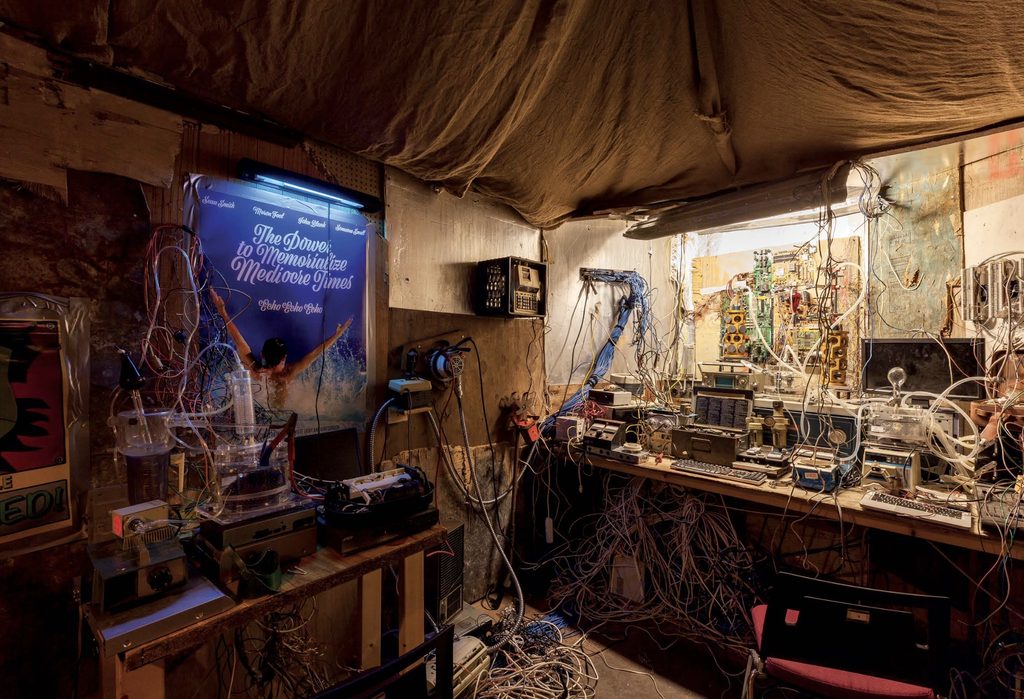
mixed-media installation, courtesy the artists and Marlborough Contemporary photo: Sahir Uğur Eren
We don’t know what the future holds for Turkey at the moment, but I guess we don’t really know that for anywhere in the world right now.
ID: Exactly. This is also an important aspect for us and something we wanted to visualise through our billboard project in different countries. Of course it was also about promoting the biennial and opening up the theme to a bigger audience, but on another level the idea was to show solidarity with the people here, while also pointing to the fact that the relevance of the theme is not limited to Turkey. What happens in one place has an effect on other places and can be mirrored onto other places. You could see this with the shift in people’s opinions in the States when Trump was elected. They suddenly understood this aspect.