
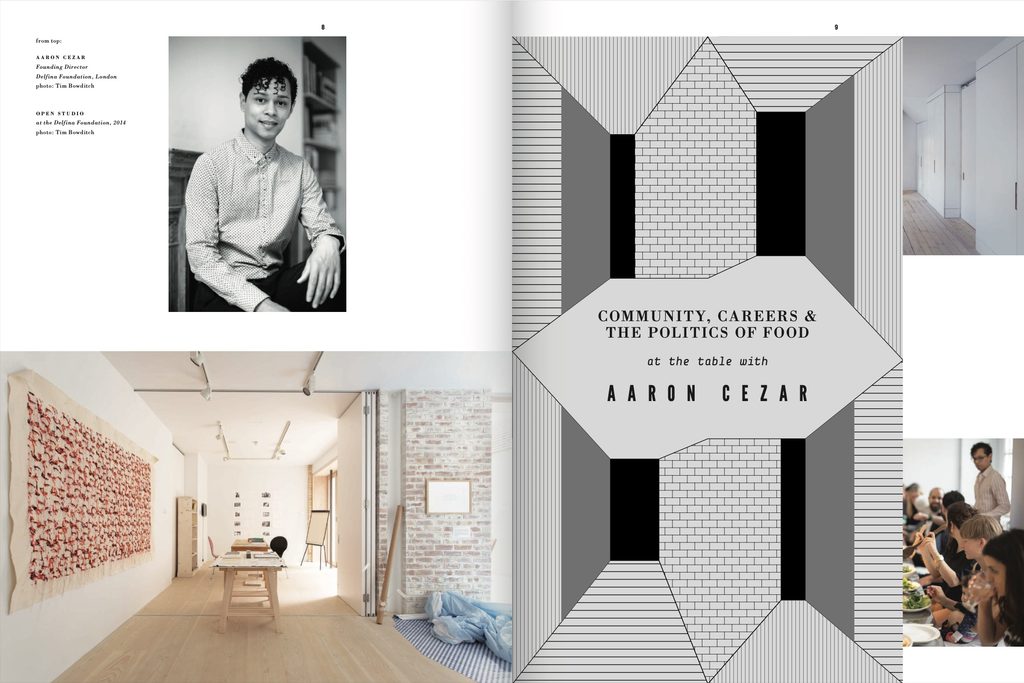
Originally published in exhibist Print Issue 8 (January 2016).
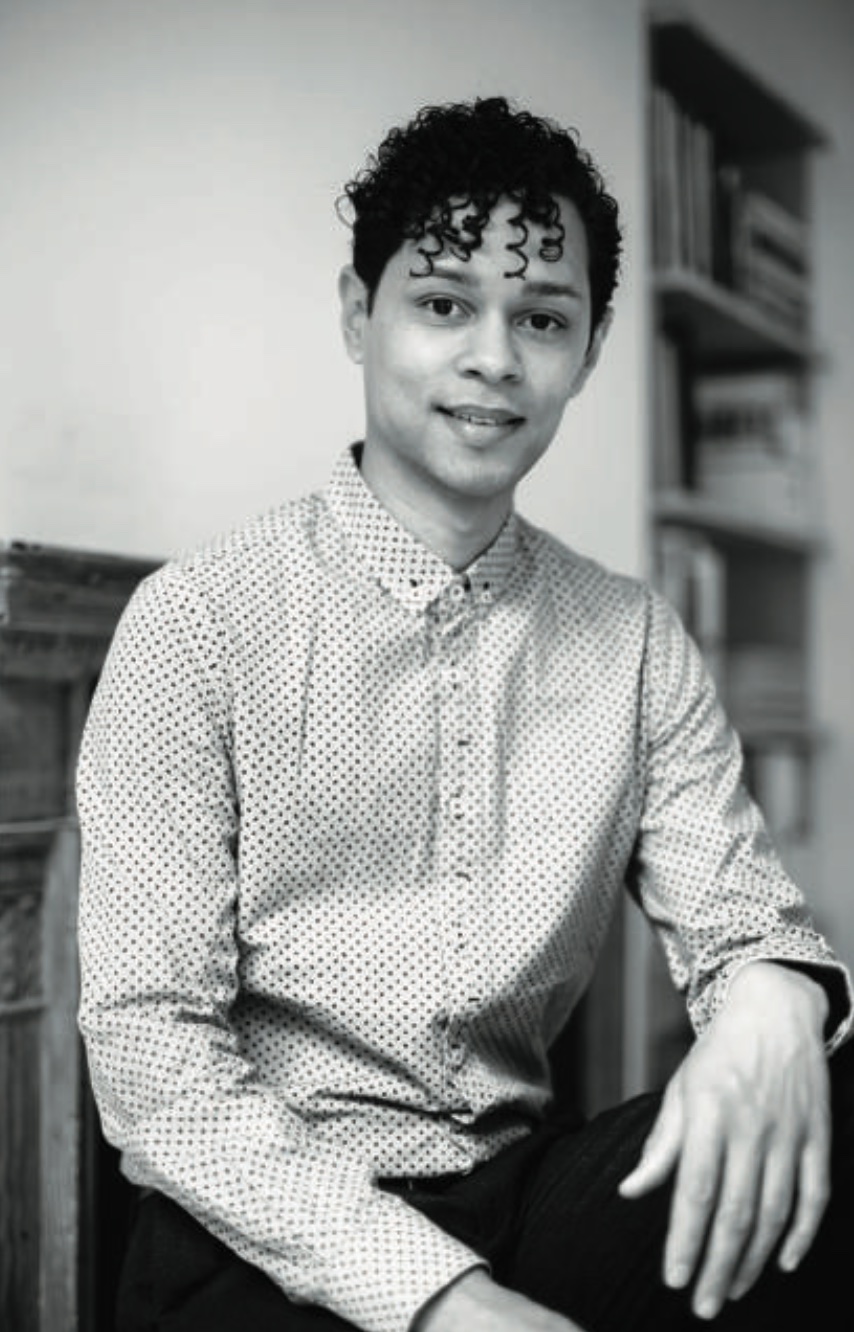
exhibist talks to Aaron Cezar, Founding Director of the Delfina Foundation, London.
Tell us something about yourself that we cannot find on the Delfina Foundation’s website, but that is important to understanding who you are!
I’m originally American, born and raised in Louisiana in the deep South, where hospitality is a strong value. It’s really no wonder that I’ve hosted some 300 artists in residence through several organisations for the last 12 years.
My previous employer was Metal, an artistic laboratory space established by Jude Kelly, who is a leading theatre director and cultural leader in the UK. I started as a project director supporting residencies in London, Liverpool and Southend-on-Sea that spanned music to visual arts. Ultimately I became the Managing Director of a consultancy that Metal established to develop creative projects with a focus on urban regeneration. We worked with property developers and local governments on projects to engage artists in communities undergoing radical change. Often the projects were opportunities for local people to voice their concerns and maintain their sense of community through dynamic cultural projects.
Can you tell us about Delfina Foundation and the support system behind it?
We are unique in terms of how we support artistic development through our residency and public programmes. More distinctly, our residency programme is based on themes, bringing together practitioners with common interests about critical issues of the day. We are also located in two houses that have been renovated into one home. Therefore, there is a strong domestic feel since the residency programme is fully residential: living and working takes place in the same space.
Delfina Foundation is not a funding body; rather, we harness resources from individual patrons, grant-making bodies, embassies and businesses to support artistic development. Our founder Delfina Entrecanales provides no-strings-attached support towards 40% of our costs and provides rent-free space, which gives us some autonomy. Therefore, we are set up as a private foundation to reflect our independence.
Delfina Foundation came out of Delfina Studios. Can you tell us more about this previous project?
Delfina Studios was famous in the art world for launching the careers of over 400 artists, including more than a dozen Turner Prize nominees. The organisation ran from 1987 to 2006, during which time it grew into London’s largest residency space with 34 studios. It was based in a former chocolate factory in Bermondsey, then a rather underdeveloped area of London. Now Tate Modern is a short walk away. White Cube’s new flagship gallery opened on the same street as many gastropubs and warehouse flats. Delfina Studios inspired the regeneration of the area.
Delfina Studios became renowned in the art world because of the number of artists who went on to have significant commercial and/or critical success – these include Wim Delvoye, Keith Tyson, Tacita Dean, Anya Gallaccio, Martin Creed, Haluk Akakçe, Susan Hefuna, Eva Rothschild, Chantal Joffe, Urs Fischer, Esra Ersen and many others.
Delfina Studios played an important role in the development of the British art scene, in particular because it provided space and opportunities to artists at a crucial time, when they were leaving the comfort of the art school and had to find a way to survive in the real world. Delfina Studios was their safety net and, in many ways, an extension of art school. It became both a community of artists and a conduit for many into an international career until it closed in 2006.
What was your role in the transition of Delfina Studios into the Delfina Foundation as founding director?
A few of our ‘artists-alumni’ recently came together and donated artworks for us to sell through a fundraising exhibition Then for Now. During our conversations about the show, many of them reflected on Delfina Studios’ sense of community. Most recalled the communal table where they all ate for only £1! When I was asked to establish Delfina Foundation with our board of trustees, I very much wanted to create a new identity for Delfina Foundation while maintaining the sense of family from Delfina Studios. My role as Founding Director was to honour the legacy of Delfina Studios. To that end, several of the artists, such as Mark Wallinger and Jane & Louise Wilson, are part of our Strategic Advisory Board. And food has become important, too! Every two weeks, we host ‘family lunch’ bringing together our residents, staff and patrons with curators, press, collectors and gallerists. In the end, everyone helps with the washing up. Family lunch embodies our values at Delfina Foundation.
According to TransArtists, a comprehensive database of artists’ residencies, there are currently more than 1,500 programs set up worldwide. Most of them started in the past 10–20 years. Why do you think that residencies are becoming increasingly popular?
Residencies have become recognised as an important way for artists to develop their careers. For those from countries where the arts education is weak, residencies are an alternative form of education and a significant way to access resources and the international arts world. Even for artists in the West, residencies provide critical exposure to new contexts and ideas. The days of the ‘studio-artist’ are long gone; artists must see and engage with the world, if only to understand their place in it.
Beyond artists, residencies serve local communities. They also provide exposure to new ways of thinking about immediate concerns. For example, Ahmet Öğüt from Turkey developed The Silent University through a residency partnership with Delfina Foundation and Tate Modern to raise awareness of the loss economy in the UK from refugees and asylum-seekers – many of whom are educated professionals, yet are unable to work. Over the last four years, the project has been extended to Berlin, Paris and Stockholm. It is relevant now, more than ever.
The benefits of residencies are increasingly recognised by funders, which has also helped with the proliferation of programmes; however, much more support is needed.
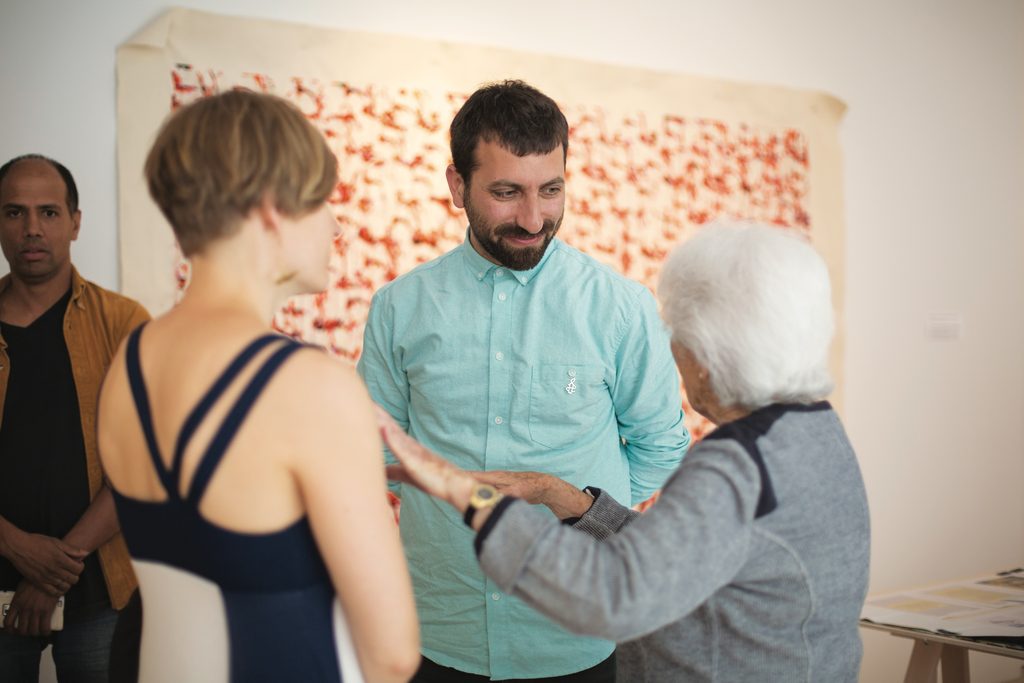
TO DELFINA ENTRECANALES photo: Tim Bowditch
Can you tell us more about The Silent University?
The Silent University is an autonomous knowledge exchange platform by and for refugees, asylum seekers and migrants. It aims to raise awareness of the systemic failure and the loss of skills and knowledge through the ‘silencing process’ where these individuals are not empowered – or even welcome to contribute to their new home country. The Silent University directly supports refugees, asylum seekers and migrants by offering an alternative education platform.
Beyond this target group, The Silent University aims to raise awareness within the general population on the specific limitations and challenges that these individuals face in host countries, which are not discussed in mainstream media. By directly empowering migrants, it projects an image of educated and entrepreneurial individuals, which is very different from the mainstream perception of them as unqualified or uneducated.
Recent debates about immigration and asylum in Europe have been dominated by a concern about the high number of applications and their unequal distribution among countries. This has led to increased xenophobia, changes in immigration policies and the rise of right-wing extremism. Within this context, EU member states have adopted measures to lower their countries’ relative attractiveness for immigrants and asylum seekers. These national measures typically affect the rights and benefits given to asylum seekers, namely the right to work, housing benefits, welfare provisions (cash payments vs. a system of vouchers) and educational opportunities amongst others. On the other hand, a significant proportion of immigrants coming to Europe have university degrees and are not able to work in their field of expertise. These limitations, which are relatively under the radar, are precisely the kind of issues that The Silent University aimed to address.
The Silent University was inaugurated at Tate Modern in November 2012 with a series of events including a symposium, a screening program, a Resource Room and a reader. It is an inspiring project that manifests the role that art can play in conceiving and reconfiguring the political, social and economic landscape of our time.
There is a huge range of residency models out there. Could you talk a little about their different functions, as well as Delfina Foundation’s focus?
There is no ‘one size fits all’ model for residencies, which is why they are ideally suited for artistic development. Residencies can be adapted as a platform for education, research and the production of new work.
Our current programme of residencies is centred on themes that consider the role of the arts in society. ‘The Politics of Food’, ‘Public Domain’ and ‘Performance as Process’ are some of the areas of interest that we have been exploring through our residencies and public programme of events and exhibitions. The themes bring together artists and thinkers around such common interests to produce new ideas.
What do you look for in potential candidates to participate in your programme? What suggestions do you have for someone applying to Delfina Foundation?
We work with artists at all stages of their career and we look at what we can provide for them. Whether they are emerging or established, we want to provide a career-defining experience.
We base our selection on a number of factors, including the career progression of the artist to date, the opportunity that the residency would create for him/her in the future, and the potential outcomes from the residency for the individual as well as their local community.
I always suggest that applicants be honest in their application and present their needs and wants truthfully. Comprehensive documentation of their work is essential as well. It is important for us to have a good picture of each applicant and for the applicant to, in turn, have a good understanding of what we do.
What advice would you give to young artists looking to go abroad for an artist residency? Which sources for research could you recommend?
As I mentioned, residencies are an ideal way for young artists to develop their practice and be exposed to new ideas. There are a number of different types of residencies as we discussed; therefore, it is important that artists understand what they want to gain from the residency experience. The residency could be a means to conduct research, produce new work, reflect on previous projects or simply have time off and away from the studio and the daily pressures of home. Many artists purposely select residencies with specific production resources such as kilns, darkrooms, and silkscreen capabilities, while others undertake residencies to have a larger studio space or to experience a particular context or country.
It is really important that artists understand what the host organisation and the city it is located in have to offer. Research is incredibly important, as well as dialogue with the organisation to manage expectations on both sides. Delfina Foundation, for example, can accommodate up to 8 residents at any one time. With interchangeable spaces of domestic size, the house is an ideal base for research and developing ideas, but not large production. We also consider the entire house, from the kitchen to the gallery, as ‘studios’ rather than having dedicated spaces solely for work.
We prefer to host a mix of residents with a range of backgrounds, from sculptural to curatorial practices; therefore, our facilities are not equipped for specific practitioners. London does, however, offer an immense amount of resources that can be accessed for specific needs.
The websites of ResArtis and TransArtists – which you previously mentioned – are excellent resources for artists to find out more about different residencies around the world, including some information on their programmes and current open calls.
Are there any other residencies you follow that have interesting concepts and projects?
There are many that I follow – all friends and colleagues! However, I will mention those who provide specific resources. Residency Unlimited, for example, offers customized residencies with many different types of institutions in New York. Like Delfina Foundation, it is also not a terribly large programme, which means that artists directly engage with the staff and director. Residency Unlimited also has an amazing website. Its ‘Opportunities’ section features a number of open calls for residencies around the world. I often point artists to their website to find residency possibilities.
I am also a fan of the Triangle Network, which is a two-week workshop model for artists. It has a vast network of organisations, many of which also offer residencies. The workshops can be an excellent short break and introduction to a place. It’s ideal for artists who cannot undertake longer residencies. Gasworks in London facilitates the network and also hosts residencies with artists from around the world.
Khoj in Delhi is another ground-breaking organisation, which is coincidentally part of the Triangle Network. While they offer different programmes and residencies, they also have a focus on different thematics – from food and ecology to gaming and technology.
Residencies in archives is also another interesting model. The Arab Image Foundation and Asia Art Archive both have had programmes to explore and interrogate issues raised by their work.
Can you tell us about some of your recent residents and their projects?
Our last thematic residencies in Autumn 2015 focused on the public domain. The programme considered how, over the last 25 years, the World Wide Web has expanded our concept of the public sphere from the physical to the virtual. We were exploring the collapse between these two realms – particularly through the use of technology and current debates on security versus surveillance, privacy versus privatization and autonomy versus anarchy.
As part of the programme, Brad Butler and Karen Mirza – two UK-based artists who work collaboratively – have been developing a new body of research, which centres on the Susurluk scandal. The process of imagining the fact, fiction and fabulation surrounding this event is a valuable part of the project, which broadly considers forms of the political imaginary. The outcome will eventually be a film, but I cannot reveal more just yet!
Generally, 2015 was a very busy year for many of our former resident artists. Eleven of them participated in the Sharjah Biennial, including Basel Abbas & Ruanne Abou-Rahme and Asunción Molinos Gordo who won prizes for their works. Fourteen former residents were in the 56th Venice Biennale, including four in the Central Exhibition curated by Okwui Enwezor, and four in the Golden Lion-winning Pavilion of Armenia, including Hera Büyüktaşçıyan from Turkey. Ten former residents participated in the Istanbul Biennial curated by Carolyn Christov-Bakargiev, including Wael Shawky, Janet Cardiff, Esra Ersen and Aslı Çavuşoğlu. Several others were acquired by major collections from Tate to MoMA to the Guggenheim. Abbas Akhavan, who was previously represented by Galeri Manâ in Istanbul, won the Sobey Art Award, one of Canada’s most prestigious contemporary art awards.
Can you talk about Delfina Foundation’s orientation towards the MENA region?
When Delfina Foundation launched in 2007, we focused on artistic exchange with the greater Middle East & North Africa. The ‘hype’ then around Middle Eastern art was at one of its highest points. Farhad Moshiri – who happens to be one of Delfina Studios’ former resident artists – became the first Middle Eastern artist to break the million dollar mark at an auction in Dubai. The Gulf Art Fair (which became Art Dubai) had just launched. Major institutions like Tate Modern were beginning to develop Middle East acquisitions groups, funded by patrons from the region. The Louvre and Guggenheim partnerships with Abu Dhabi were announced; the Marrakesh Biennial was finding its feet and the Sharjah Biennial was re-affirming itself as an international contender. Qatar, meanwhile, was carefully plotting its own strategy. It was a time of potential – and speculation – for many, such as gallerists hoping to populate the new museums rising from the Gulf, uber curators looking for the next hot exotic thing, and museums in the West looking finally to address the gaps in their collections from this overlooked region and in the meantime gain new patrons.
All these developments were very relevant to why Delfina Foundation focused initially on the Middle East. In and amongst this context and all of this speculation, we recognised that many artists were perhaps being sent the wrong messages about the art market being the only place where one’s work would be validated – especially since the young market there deterred those from experimenting, taking risks and taking time out to further develop their practice.
As a result, many artists felt isolated – and this was not only from the art market, but also from each other and the international art scene. You see, the ongoing backlash of 9/11 meant that visas were still complicated to secure and borders were tightened.
In short, it was important then to give priority to the region and to promote artistic development because of the divisive language in the media following 9/11 and then the sudden boom in the Middle Eastern art market that could have dominated how art – and what type of art from the region makes it into the world.
Over the last few years, we have shifted our remit from geographic exchange to knowledge exchange with the aim of creating an artists’ ‘think tank’ around different themes. We now develop more international collaborations with the Middle East & North Africa around common practices, rather than working with the region in isolation.
You have a strong history of residents from Turkey. What is your connection to Turkey?
Turkish artists and curators have participated in our programme, from Delfina Studios to Delfina Foundation. When we started Delfina Foundation, we took a wide view of the Middle East & North Africa, often working with countries that outline the region, such as Iran, India, Turkey and Azerbaijan. In fact, one of the first residency exchanges that we developed was in collaboration with Platform Garanti in Turkey, The Townhouse in Egypt, Ashkal Alwan in Lebanon, Spike Island in the UK and Vector Association in Romania. Over two years, the network supported 17 resident artists across six institutions with funding from the British Council.
We are thankful for the support from many individuals and SAHA, in particular, who have enabled us to provide residencies for Merve Ünsal, Işıl Eğrikavuk, Övül Durmuşoğlu and Onur Gökmen in recent years.
SAHA has quickly become such an influential organisation in the absence of public funding for international projects by Turkish artists and curators. It is also a model of patronage that should be celebrated and repeated in many other countries.
Have you collaborated further with any of the past residents from Turkey?
We have been an ongoing partner in Ahmet Öğüt’s The Silent University since its inception through our joint residency with Tate Modern. We also presented his first solo show in London.
Aslı Çavuşoğlu undertook a residency with Delfina Foundation in partnership with Frieze Projects in 2012. At Frieze Art Fair, Çavuşoğlu produced a real-time performance involving a professional drama crew and actors who developed a scripted crime drama at the fair – a live TV production. A year later, during Frieze Art Fair 2013, we invited Aslı back to exhibit Murder in Three Acts, the outcomes of the previous performance. The three video episodes follow detectives on their quest to solve a murder that took place in an exhibition space where artworks appear as both clues and weapons. The films, all produced at Frieze Art Fair 2012, perfectly mimic the fast-paced, slick style of well-known crime dramas such as CSI.
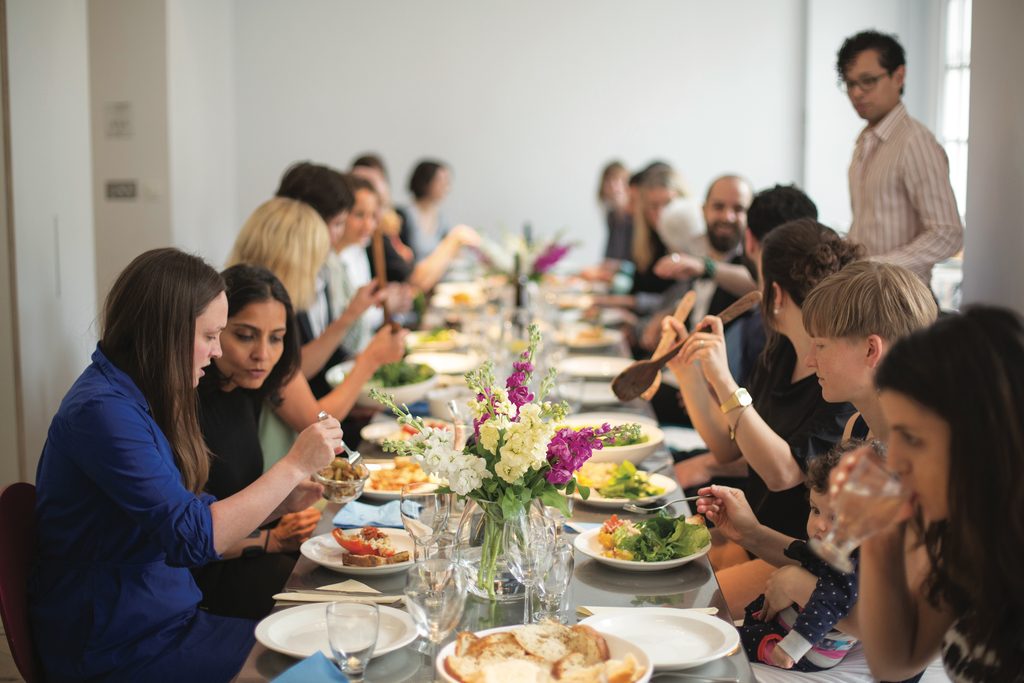
at the Delfina Foundation, 2014
photo: Tim Bowditch
What projects are you excited about for 2016?
This March, we are planning to exhibit Didem Pekün’s Of Dice and Men, a two-channel film, which was partially produced during her residency at Delfina Foundation in 2013. It will be her first solo show in London.
The film is a video-essay, a moving diary that uses the fluctuating rhythms of everyday life, punctuated by moments of subjective consequence and markers in a shared history. The two screens seem to be in dialogue across the gallery space as well as across different places: London and Istanbul, two cities which Pekün’s life straddles – and as she says ‘is torn between’. It includes footage of the Occupy movements that began in London in 2011 as well as Istanbul’s Gezi protests in 2013, interlaced with more joyful and elusive experiences – boys diving into the Bosphorus or a first encounter with a feat of nature.
Through its cyclical composition and meditative, rhythmic temperament Of Dice and Men speaks to the repetitive flow of history. The exhibition runs throughout March 2016 at Delfina Foundation with events. We are happy to have SAHA’s support on this project.
We are also excited by our annual programme The Politics of Food, which will resume this summer. It’s the third season of our four-year programme that has thus far brought together over 70 artists, activists, anthropologists, agronomists, chefs, curators, scientists and writers from 32 countries through residencies, events and exhibitions. The first season in Winter 2014 introduced a number of general environmental, economic and social concerns that have guided our overall programme, while the second season in Spring 2015 explored the relationship between food and three sub-themes: Sex, Diet & Disaster. In Summer 2016, our sub-themes Markets & Movements will continue to investigate the production and distribution of food. We are in the final stages of selecting the participants and shaping the programme. Exciting!