
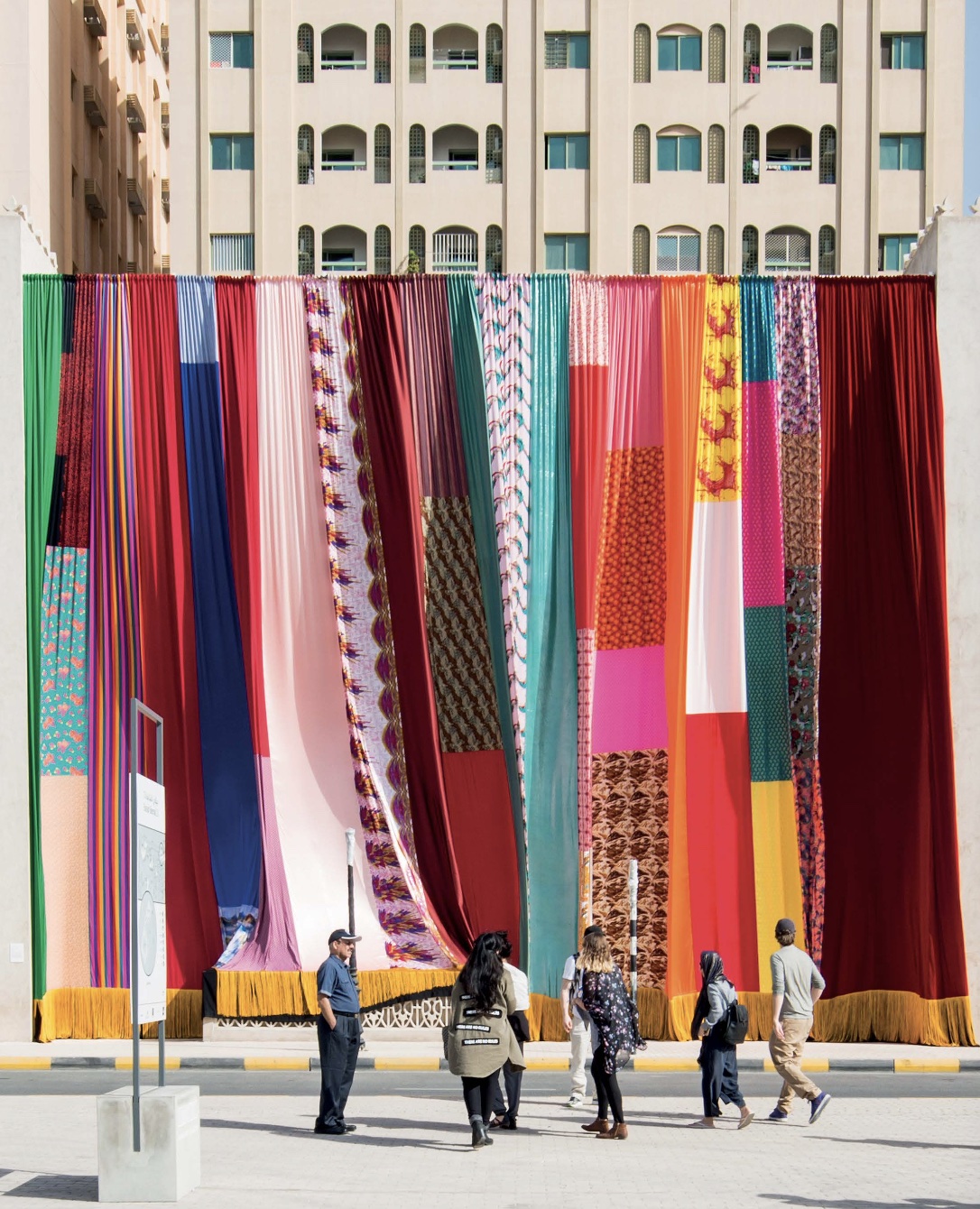
Originally published in exhibist Print Issue 13 (September 2017).
An essay on transcultural spaces and darker modernities by Stephanie Bailey.
“Why not simply posit modernity as the new historical situation, modernization as the process whereby we get there, and modernism as a reaction to that situation and that process alike, a reaction that can be aesthetic and philosophico-ideological, just as it can be negative as well as positive?”
— Fredric Jameson¹
In March 2017, I held a talk within the frame of the 11th Global Art Forum at Art Dubai that was written in response to the forum’s theme, Trading Places, which considered the history of trade and its cultural impacts from the context in which the forum was being held: an art fair. A work in progress, this is a reworked, extended and at times corrected version of that talk: a condensed introduction to my ongoing study of the global network of art fairs and biennials as a microcosm of the art world industrial complex through which the processes of globalization and its affects might be observed.
But before I go further, I wanted to start by introducing myself. I was born in Hong Kong a year before the Sino-British Joint Declaration was signed, which ensured the return of the city to China in 1997 after the territory was ceded to Britain in the mid-nineteenth century as a result of the first Opium War – a conflict that expressed the British Empire’s thirst for Chinese markets. On paper, I am half-British, half-Chinese – a child of empire, and a hybrid product of a violent history in which trade forms a central plotline. This condition was the subject of an issue of LEAP magazine that I guest edited in 2016, which considered art after identity politics in the 21st century, when cultural hybridity and historical complexity have come to define people on personal and collective levels – a complexity that, as Anders Kreuger and Nav Haq have noted, the art world is not always capable of handling, despite it being a space of transcultural exchange where hybrid bodies intermingle².
Yet the art world is also a hybrid product of empire. At least, this is what I am going to propose by weaving a spectral frame around two exhibition formats that define it on global terms – biennials and art fairs – in order to think about the transcultural dynamics inscribed into their forms³. To do this, I want to pull back to a single event in 1851: The Great Exhibition of Works and Industry of All Nations, commonly regarded as the first World’s Fair. Organized by Queen Victoria’s consort Prince Albert and Henry Cole, this was an imperial extravaganza celebrating a burgeoning industrialized capitalism. It was staged at London’s Hyde Park in a pre-fabricated building constructed out of iron and glass: the Crystal Palace. Some 15,000 contributors participated, with Britain taking one half of the space alongside exhibits from the colonies (such as Canada, Africa, India and the Caribbean), and the rest of the world (including France, Austria, the United States, Turkey and Egypt) taking the other⁴ ⁵. The show went on for months and attracted some six million visitors – numbers facilitated by a period of rapid industrial progress that produced transformative engineering feats including steamships that could cross the Atlantic in two weeks⁶.
At the time, Prince Albert described a moment of “wonderful transition,” when distances once separating “the different nations and parts of the globe” were “rapidly vanishing before the achievements of modern invention.”⁷ These developments, he supposed, pointed towards the fulfilment of what he called “that great end, to which, indeed, all history points – the realization of the unity of mankind.”⁸
The Great Exhibition both visualized this imperial notion of “unity” and propelled it forward. As Sally Mitchell writes, after the event, London became a metropolis, in part furnished by funds the exhibition had raised, which were used to acquire the land to build the Victoria and Albert Museum, the Natural History Museum and the Science Museum. The new Houses of Parliament were built, work on the Underground began, sewers and water pipes were laid and department stores began to line Oxford Street, Regent Street and Piccadilly Circus⁹. In 1858, the construction of the first transatlantic telegraph cable was completed, followed by a more successful attempt in 1866, though the first submarine telegraph link between Dover and Calais was completed in 1851¹⁰. Then, in 1869, the Suez Canal opened, creating faster sea routes to India and the Far East.
In this context, the exhibition not only reflected a globalized process of industrial development and capitalist expansion inscribed with imperial aims; it offered a model through which to harness these dynamics through soft power. This was reflected in the exhibition space, where colonial strategies were enacted through means of cultural and material categorization. As Paul Young details, aboriginal products were described in terms of what they comprised, and not what they signified; “stripped of any cultural resonance and offered up… raw.”¹¹ The China exhibit, meanwhile, which had little to no participation from the Chinese state, was met with a derogatory critique – of exhibiting the qualities of art exemplified by the early stages of civilization¹². “What occurred here,” Young observes, was “a pronounced exhibitionary drive to strip Non-European communities of cultural and historical significance in order that they might be easily and profitably assimilated into global economy” – an economy with Britain at the centre¹³. Trade was seen as a form of cohesion, in which supply and demand, not to mention the tiers of industrial production and consumption, became the new bonds that might not only fuse the British Empire while organizing it along industrialized hierarchies, but also expand its boundaries further. In reflection of this intention, William Felkin, then mayor of Nottingham and “displayer of lace” at the exhibition, noted: “To induce all the world to become customers and consumers would appear to be the wisdom of our country and our age.”¹⁴
This supposed message of productive capitalist unity offered a counterpoint to the events taking place within Britain and throughout Europe at the time, including the revolutions of 1848 and the publication of Marx and Engels’ Communist Manifesto that same year, which not only raised concerns about the future of capitalism, but also provoked anxieties around class tensions within the United Kingdom¹⁵. In response, the Great Exhibition presented an optimistic image of imperial power. Aside from its international list of exhibitors, the Great Exhibition’s organizing committee included, as The Times noted, “every shade of political opinion in the country,” and after May 24, the fair admitted all classes into the halls¹⁶. The exhibition, in this light, was a political act of social engineering: a regulatory spectacle for the national population, in which a sense of national identity was ultimately constructed out of the perspective of Empire. It even appeared to embrace the revolutionary mantra of the period by filtering it through its ideological branding. Take a statement made in January 1851 by The Times, which proclaimed how the event would “open men’s eyes with what may be done and what will be done with the means in our possession.”¹⁷
All of which was smoke and mirrors to Marx and Engels, who called the spectacle (albeit in 1850) “a striking proof of the concentrated power with which modern large-scale industry is everywhere demolishing national barriers and increasingly blurring local peculiarities of production, society and national character among all peoples.”¹⁸ Later, in an 1853 New-York Daily Tribune dispatch, Marx would reflect on the British impact on India in a way that would recall the processes of reduction that took place within the Great Exhibition itself, accusing England of “breaking down the entire framework of Indian society… not so much through the brutal interference of the British tax-gatherer and the British soldier, as to the working of English steam and English free trade.”¹⁹ Using culture and industry as means of engagement and competition, the Great Exhibition was a weaponized space – a format used to enact the economic violence of a global and industrialized trading power.
So the World’s Fair was not really a world’s fair. It was an imperial marketplace and an engine of modernity, designed not only to assert the power of an imperial – or sovereign – power, but to also shape the world through that power’s designated narrative. As Stuart Murray writes: “By 1855 every nation with colonial possessions wanted to display both the economic potential and the exotic difference of their empires. In part, this clearly aimed to reveal the benefits of imperial tenure, validating and legitimizing the colonial process…”²⁰ The 1904 St. Louis World’s Fair in the US celebrated the centennial of the Louisiana Purchase, the acquisition of said territory from France by the US in 1803; it featured a live exhibition of Filipinos – a reflection of the recent annexation of the Philippines by the US following the Spanish-American War²¹. The overtly imperial tone of the fair adds a dark shadow to the words fair president David Rowland Francis used to inaugurate that event: “Open ye gates. Swing wide, ye portals.”²² Be open. Be worldly. But under a sovereign power’s conditions. Sharing thus becomes conforming. In this unity, being global means supporting and propagating a system of capitalism that is rooted in imperial strategies.
This brings me to Dan Smith’s summary of the 1851 Great Exhibition. Smith argues that the event “helped forge western modernity’s formations of display, spectacle, surveillance and commodity” and “determine the form of the modern museum and gallery as well as spaces of commerce, denying any possibility of conceptually separating these sites.”²³ Smith aligns this assertion with sociological historian Tony Bennett’s description of the “exhibitionary complex” – “an arrangement of institutional forms that are museological but also encompass modes of public spectacle, and sites of commodity arrangement and exchange.”²⁴
I consider biennials and art fairs – and other large-scale periodic exhibitions, such as triennials and quinquennials – part of this exhibitionary complex. That the Venice Biennale was launched in 1895 as a direct result of the trend that the 1851 Great Exhibition kicked off is telling. The Venice Biennale marked the birth of countless more exhibitions like it: a very specific world stage through which cultural politics and cultural economies are produced, performed, negotiated, asserted, and regulated in a mediatory space. There is also a wonderful symmetry to the fact that documenta, created in Kassel in 1955 by Arnold Bode, staged a show in 1972 that came to be known as a curatorial game-changer – Harald Szeemann’s documenta 5, which saw the rejection of classical forms of curatorial framing in favour of a more conceptual, cross-disciplinary approach that would be described as Großausstellung: Great Exhibition. Art fairs are also descendants of the World’s Fair’s exhibitionary form. Take Art Basel, started in 1970 and now operating as a (high) culture industry “World’s Fair” across three regions, the Americas, Asia, and Europe, spanning scores others like it.
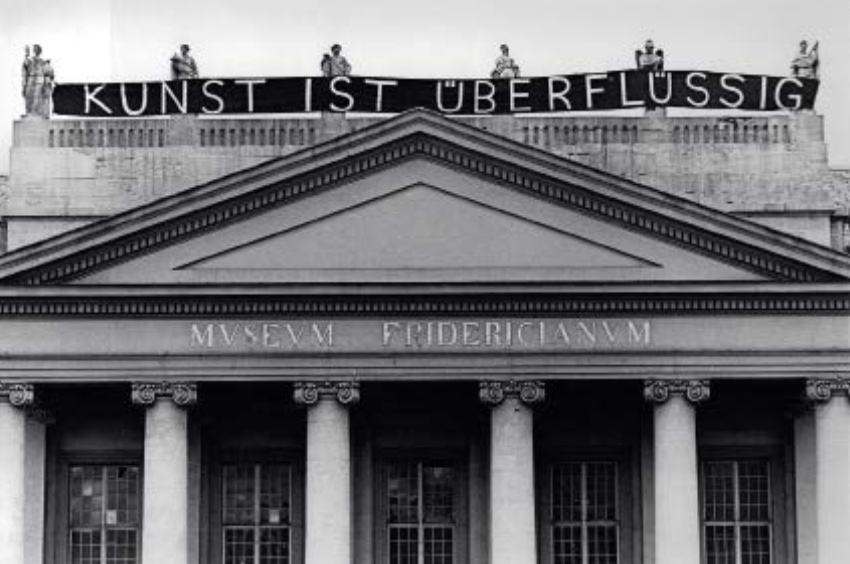
at Museum Fridericianum Kassel, © documenta archive/ Manfred Vollmer and VG Bild-Kunst/ Ben Vautier
There is no denying the overlaps between the World’s Fair phenomenon of the nineteenth and twentieth centuries and the transcultural framework of today’s art fair–biennial complex, which constitutes a network that unites a transglobal population through art, culture, and a global industry and market for both. And note here, that when I speak about culture, I am keeping in mind Fred Inglis’ assertion that the study of culture is the study of power²⁵. And when I say art world, I mean a rhizomatic marketplace of culture and exchange – a mechanism of capital precisely because of the historical processes that are embedded into its apparatuses, including biennials and art fairs, whose formats mirror the kind of world-making process the 1851 Great Exhibition encouraged to unite the world and its economies in a global, or globalizing, space. But this global space (what Foucault might call an apparatus of security) is itself inscribed with hierarchies. Take, for instance, Artsy’s numerical breakdown of “Race and Ethnicity” representation at the 57th Venice Biennale in 2017:²⁶ figures appear like a pyramid scheme, with “57% white” at the top of the list and “1% First Nations” at the bottom, recalling Wu Chin-Tao’s description of the global art world’s “basic structure” as “concentric and hierarchical…”²⁷
When entering any art fair or biennial, then, we are entering a space where historical globalization is at work. As the 1901 Pan-American Art Handbook for visitors informed its readers: when you enter the gates, you become part of the show,²⁸ and today this show sounds uncannily familiar. According to Pamela M. Lee, the contemporary art world is “both object and agent of a market system that is inextricably linked to the processes of globalization – a process that, with the aid of technology, is charging ahead with one of the ‘most insidious mantras’²⁹ calling for ‘a “borderless” world of smooth flows, unimpeded international travel, and ever-expanding networks of limitless communication.’”³⁰ As Lee notes, biennials have come to stand as a country’s “cultural point of entry into [a] global economy.”³¹ Art fairs could be described in the same way. Under such circumstances, to borrow Paul Werner’s words on the museum as a conglomerate, “the very admiring of art becomes an adherence to a free-market ideology”³² that the 1851 Great Exhibition encouraged. Through these spaces, we can watch how historical capitalism, hinged as it is on the imperializing processes of industrial modernization, is being transformed into a neoliberal globalism that thrives on unregulated flows within a circulatory system. (What Fredric Jameson today might call a “universal market order.”³³)
But while the global sentiments behind these exhibition formats harbour a darker modernity, to borrow Walter D. Mignolo’s phrase, this does not mean we should write off these spaces, either. Often opaque, an art fair could also be read as an example of an informal market, as identified by Helge Mooshammer and Peter Mörtenböck: places where the conditions to produce “a volatile body of knowledge” that “passes between informal global structures and the subject emerging from them” are made³⁴. To read a biennial as a place where the image of a future global order is appearing out of a political, cultural and historical blend of objects and bodies, is to understand it as a site of transformative and active breakdown as well as a site of problematic, conflicting or contradictory formation. Art Dubai and the Sharjah Biennial are cases in point; both events have exploited each exhibition platform as a site of negotiation with various publics, from local and regional to international, and as a way to assert a presence on the global stage on terms that counter those offered by the western world, albeit within a structure that has its roots in the imperial forces that the UAE liberated itself from in 1971. In these instances, we see what Doreen Massey describes as both a spatializing and globalizing of modernity’s story – gestures with intentions to “rework modernity away from being the unfolding, internal story of Europe alone.”³⁵ This spatializing rejects a singular universal – in which progress is perceived as a single line of progression, or what Massey describes as a historical queue – to become a site in which multiple trajectories co-exist, intermingle and overlap, often times in productive dissensus³⁶.
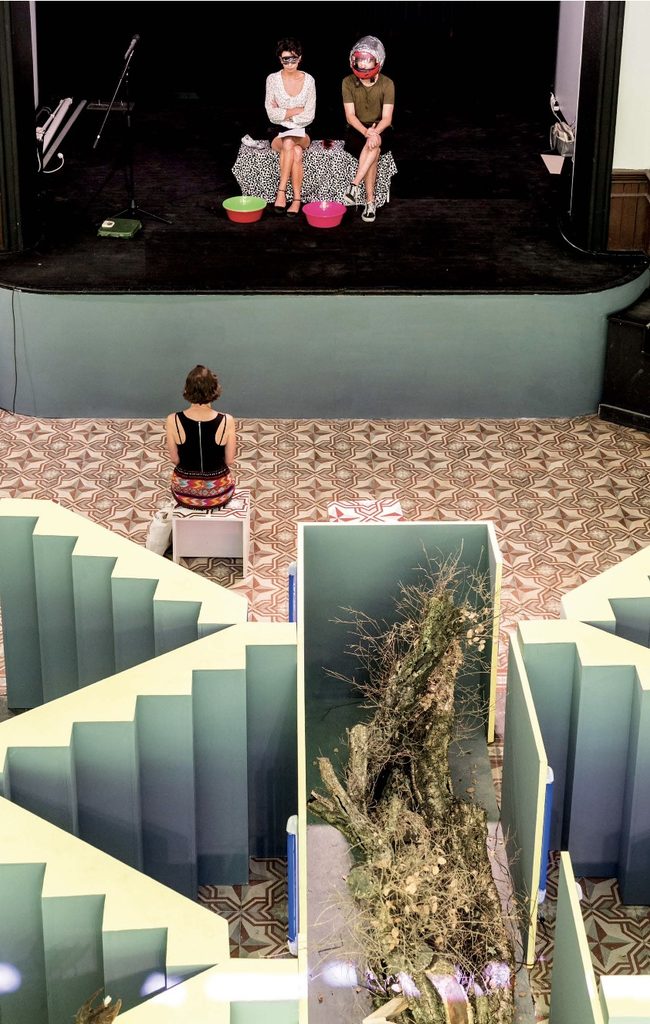
installation and performance at Galata Greek Primary School, 13th Istanbul Biennial, 2013 photo: Servet Dilber, courtesy the artist and Gallery Nev Istanbul
The idea of an emergent world that is breaking through the borders and hierarchies solidified in the last centuries was actually the reason why I chose the Istanbul Biennial, and not Venice, to be my first biennial experience beyond Athens back in 2009. Venice, with its antiquated national pavilions, was clearly the past. Istanbul, I reasoned, was the future: an exhibition consistent in exploring what it means to be a body in a world as palimpsestic as ours in a city formed from the great and messy material drama that composes human history. Such messiness was invoked in the 11th Istanbul Biennial’s exhibition title, What Keeps Mankind Alive?, taken from Brecht’s 1928 The Threepenny Opera by curators WHW (What, How & for Whom). The question became a starting point to consider the politics of art at a time the curators compared with 1928. “Again we live haunted by the fears of approaching global changes, consequences of which could have lasting disastrous effects, not unlike those that transformed the world after the economic collapse of 1929,” one statement reads³⁷.
Just under ten years later, the title of this year’s 15th Istanbul Biennial, Elmgreen & Dragset’s A Good Neighbour, could not be a more fitting provocation when it comes to thinking about relations of proximity in a place that feels like a microcosm composed of microcosms – where time is condensed and compressed into bodies and buildings that stand like live texts of a never-ending story told in an infinity of fragments. Art fairs and biennials are also such microcosms: where the processes, relations and discourses that are occurring around the development of the histories from which these exhibition formats emerged are not only made visible, but also produced, narrated and at times revived and re-assembled.
This sense of ongoing compression, at once expansive and reductive, is perhaps the main reason why the art fair–biennial complex is such a fascinating landscape of objective study when it comes to observing how “the standardization projected by capitalist globalization”³⁸ – of which the end goal appears to be full global union – is crafted, and in turn, crafts its subjects. As spatial and organizational forms that both organize and represent a wider network of intricate and localized infrastructures, art fairs and biennials represent and facilitate a process that is highly contradictory precisely because it operates within a historical system of global production and exchange in which global culture is programmed to homogenize heterogeneity through a process of unification. The result of which is a form that, returning to where this essay began, ultimately looks very much like my own.
Notes
- Fredric Jameson, A Singular Modernity: Essay on the Ontology of the Present (Verso: 2002), p. 99.
- Anders Kreuger and Nav Haq, Introduction to Don’t You Know Who I Am? Art After Identity Politics, at Museum of Contemporary Art, Antwerp (June 13 to August 14, 2014).
- As Morna Daniels writes in “Paris National and International Exhibitions from 1798 to 1900: A Finding-List of British Library Holdings,” Electronic British Library Journal (EBLJ), 2013, on the tradition of exhibitions in France: “The series of the great exhibitions of the nineteenth century began in the seventeenth century, with exhibitions of works of art. These were held biannually from 1667 to 1793, with the exception of 1677, 1679 and 1708 to 1725. From 1793 to 1802 they were annual, before reverting to a biannual pattern under the Empire.”
- Liza Picard, “The Great Exhibition,” The British Library, published online on October 14, 2009.
- “The Canadian exhibit was located on the Ground Floor. It took its place with other British colonies all contained within the western half of the huge building devoted to Britain and her Empire, while the eastern half accommodated the displays of other nations.” “Canadian Representation at the 1851 London Great Exhibition and the 1855 Paris Exposition Universelle,” Histoire Sociale, 32:63 (2001), p. 15.
- See: “Steam & Speed: The Power of Steam at Sea,” on the Victoria and Albert Museum website.
- Jeffrey A. Auerbach, The Great Exhibition of 1851: A Nation on Display (Yale University Press: 1999), p. 60.
- See: Auerbach, p. 60.
- Sally Mitchell, Daily Life in Victorian England (Westport: Greenwood Press, 1996), p. 8.
- The Institution of Engineering and Technology.
- Paul Young, “Mission Impossible: Globalization and the Great Exhibition,” Britain, the Empire, and the World at the Great Exhibition of 1851, edited by Jeffrey A. Auerbach and Peter H. Hoffenberg (Ashgate: 2008), p. 16.
- See: Francesca Vanke, “Degrees of Otherness: The Ottoman Empire and China at the Great Exhibition of 1851,” Britain, the Empire, and the World at the Great Exhibition of 1851, edited by Jeffrey A. Auerbach and Peter H. Hoffenberg (Ashgate: 2008), p. 201.
- Young, p. 16.
- See: Young, p. 18.
- Auerbach, The Great Exhibition of 1851: A Nation on Display, p. 29.
- Liza Picard, “The Great Exhibition,” The British Library, published online on October 14, 2009.
- See: Young, p. 15.
- See: Kevin Hetherington in Capitalism’s Eye: Cultural Spaces of the Commodity (Routledge: 2014), p. 14.
- Karl Marx, “The British Rule in India,” first published in New-York Daily Tribune, June 25, 1853.
- Stuart Murray, p. 17.
- Greg Allen, “Living Exhibits at the 1904 World’s Fair,” NPR, published May 2004, and Sharon Delmendo, The Star-Entangled Banner: One Hundred Years of America in the Philippines (UP Press: 2005), p. 51.
- Joe Sonderman and Mike Truax, St. Louis: The 1904 World’s Fair (Arcadia Publishing: 2008), p. 18.
- Dan Smith, Traces of Modernity (Verso: 2012).
- Ibid.
- Fred Inglis, Cultural Studies (Blackwell: 1993), p. 185.
- Artsy, “Venice Biennale Artists by the Numbers,” May 3, 2017. Quoted from my editorial for Ibraaz Platform 010, “Now Where?” published August 1, 2017.
- Chin-Tao Wu, “Biennials Without Borders?” Tate Papers, Issue 12. Quoted from my editorial for Ibraaz Platform 010, “Now Where?” published August 1, 2017.
- Alison Griffiths, Wondrous Difference: Cinema, Anthropology, and Turn-of-the-Century Visual Culture (Columbia University Press: 2002), p. 74.
- Pamela M. Lee, Forgetting the Art World (MIT Press: 2012), p. 14.
- Ibid.
- Ibid.
- Paul Werner, Museum, Inc.: Inside the Global Art World (Prickly Paradigm Press: 2005), p. 20.
- Fredric Jameson, p. 13.
- Helge Mooshammer and Peter Mörtenböck, “Trading Places,” Networked Cultures (NAi: 2008), p. 156.
- Doreen Massey, For Space (SAGE: 2005), p. 63.
- Massey, p. 69.
- 11th Istanbul Biennial curatorial announcement, e-flux, May 21, 2009.
- Jameson, p. 12.