

Originally published in exhibist Print Issue 10 (October 2016).
By Jussi Parikka.
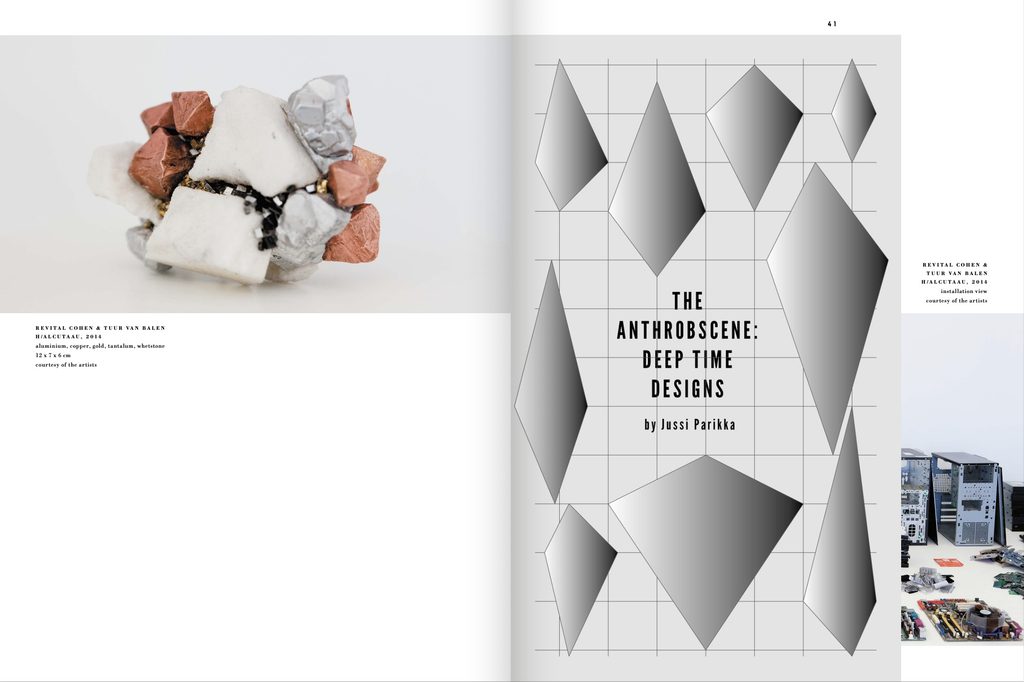
This text consists of slightly edited short excerpts from the longer essay Anthrobscene (University of Minnesota Press, 2014) and the book A Geology of Media (University of Minnesota Press, 2015). It follows a similar idea that design theorist Benjamin Bratton posed in a different context: consider the effect of the Anthropocene, the term for the massive geological impact of advanced human science and technology, industrialisation and then the atomic age, on the planet as a design brief that spans over hundreds of years. How did we accidentally design the situation of planetary-scale destruction of the environment and our living conditions? Here the concern is especially about the particular materials of design culture of digital media: the supposedly immaterial digital realities of screens and code, which exist only because of massive planetary infrastructures, energy production, data farm facilities and mineral extraction. A focus on materials such as coltan and tantalite has surfaced during the past years as an alternative way to understand design culture that starts not from the slick product on our laps, but from the processes of mining and refining that produce such materials essential for computers, gaming consoles, etc. The periodic table and rare earth elements become part and parcel of our vocabularies of technology. This is also something that comes out in the nomadic design studio Unknown Field Division’s works over the past years: mapping the planetary conveyor belt and the distant geographies of materials and resources that are connected to the production of the contemporary moment, from smart cities to digital entertainment gadgets. Also artists such as Revital Cohen and Tuur van Balen, who are exhibiting in Istanbul at the Design Biennial, have imagined alternative temporal, chemical and geographic ways to see the world of material production.
And the other side of the story is the things left behind: electronic waste as one key concern, as the dead media pile builds up as the fossils of the future, ready for a design historian in 2390 who wonders about the trail of our garbage. To think of geologies of design and media is to switch our temporal scale, our understanding of which time our activity belongs to. This speaks to the themes of this year’s Istanbul Design Biennial, and also develops an idea of looking at media cultural design from the perspective of a different time that preceded, and will likely succeed, human life.
This is an essay about not only the anthropocene but the anthrobscene. It responds to past years of discussions in art, design, cultural theory and philosophy about the geological underpinnings of contemporary media culture. In short, the term anthropocene has been at the focus of intense debate: a concept to describe the effects of the human species and its scientific-technological desires on the planet. And yet it is a concept that also marks the various violations of environmental and human life in corporate practices and technological design culture that is ensuring that there might not be such an anthropocentric future.
The notion of the anthropocene was preceded by the 19th-century conceptual invention of the anthropozoic age. Antonio Stoppani stands as one of the early formulators of the idea that with humans also a specific geological period ensues. His 1870s visionary accounts painted a picture of the various strata of the earth. But for Stoppani, in Corso di Geologia (1873), such layers were not only ones of Earth’s prehistory but a planet unearthed by human technologies and then covered with the ruins of those inventions. The Earth feeds that process and disappears under it:
“Rival of the potent agents of the internal world, man undoes what nature has done. Nature has worked for centuries at agglomerating in the bowels of the earth oxides and metallic salts; and man, tearing them out of the earth, reduces them to native metals in the heat of his furnaces. In vain you would look for a single atom of native iron in the earth: already its surface is enclosed, one could say, within a web of iron, while iron cities are born from man’s yards and float on the sea. How much of the earth’s surface by now disappears under the masses that man built as his abode, his pleasure and his defense, on plains, on hills, on the seashores and lakeshores, as on the highest peaks! By now the ancient earth disappears under the relics of man or of his industry. You can already count a series of strata, where you can read the history of human generations, as before you could read in the amassed bottom of the seas the history of ancient faunas.”¹
Stoppani imagines the future fossil layers of technological rubbish and paleontologies which deal not only with the Earth, but the Earth after the appearance and effect of human modern science and technology.
In design and media studies we are already aware of the work by Bruce Sterling (dead media, media turned paleontological) and Siegfried Zielinski (deep time of the media). The geophysical sphere is not left for geologists but discussed by speculative designers and media artists, for example at art festivals such as the transmediale Afterglow festival (2014) in Berlin. Even entering the Haus der Kulturen der Welt conference venue opens up to a view of several survey instruments, reinstalled so as to function as peephole-style viewing devices – not to the geological landscape, but instead to media landscapes: measurement of online activities and processes. The Critical Infrastructure project by Jamie Allen and David Gauthier is emblematic of this interest in geological and geophysical metaphors in media, design and technology. In addition, it is complemented by the growing interest in the electronic waste and fossil-centric energy use that still powers, for example, many of the data farms that sustain infrastructures of online media².
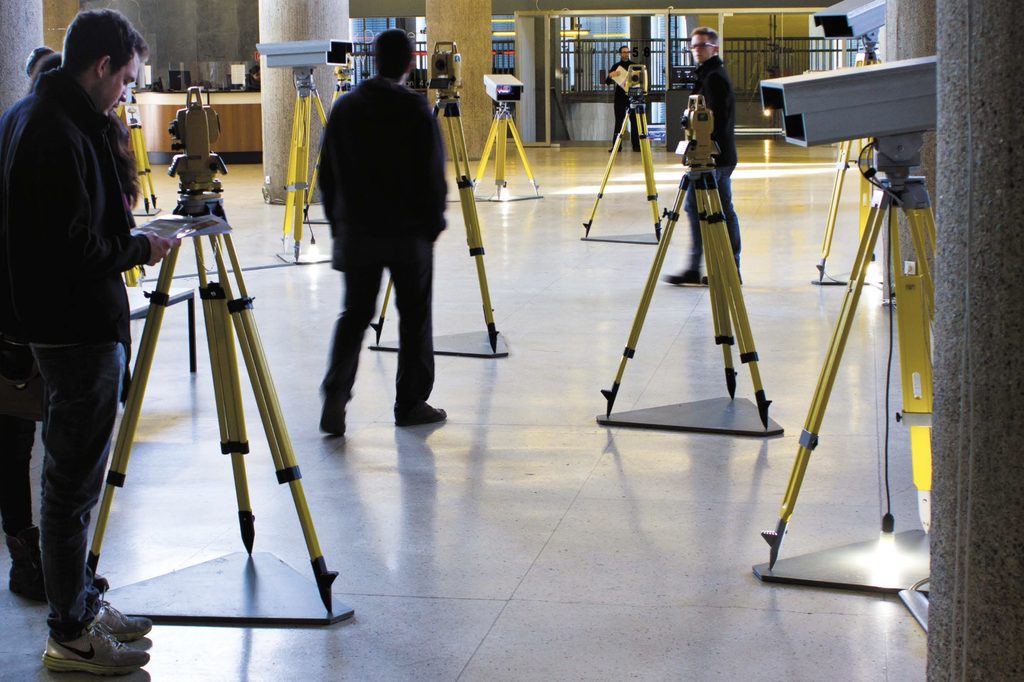
installation view at the HKW Berlin, transmediale 2014 photo: Daniel Rakosi / transmediale
One can start reading the history of media and technology before media becomes media. Oddly enough, even statistics about minerals tell this story: the increase since the 1990s in the consumption of indium, peaking in 2008; the growing numbers in import and consumption of silicon since the 1950s; a similar increase in consumption of rare earth minerals since the 1950s³. Advanced technological culture is dependent on minerals and multiple kinds of materials. One can read changes in design culture through the materials we use: now, it would be relevant to call ours a design culture of rare earths.
Deep time resources of the earth enable technology to be born. The emergence of geology as a discipline since the 18th and 19th century, as well as the techniques of mining developed since then, are essential for media technological culture. Institutions such as the U.S. Geological Survey have gradually grown to be about much more than “just” geology: they are sites of transformation where the Earth becomes an object of systematized knowledge and the knowledge provided of the Earth’s resources becomes mobilized towards technological production, governmental geopolitics and increasingly a global survey of the minerals of the Earth.
In addition to being able to extract a history of media from the sciences of the earth, artistic practice from sculpture to painting to for instance the chemical worlds of photography has had a close relationship to Earth’s materials. Art has turned chemicals, clays, pigments into expressions of not only any romantic artistic spirit but the existence of the earth: an understanding of the Earth’s tendencies to create sound, light, and more⁴.
A geology of media is a theoretical contribution to the analysis of this situation of the anthrobscene, and this essay is a preamble to a bigger book project carrying that name: A Geology of Media.
Throughout this essay I am interested in alternative accounts of how to talk about the materiality of media, design and technology. This is not merely for academic reasons, or even to enhance artistic vocabulary, but it is something that comes with an ethical urgency too. One aspect, with a concrete ecological edge to it, is the acknowledgement of the growing e-waste problem resulting from discarded media technologies⁵. And another aspect relates to energy and power as already mentioned above. Indeed, what I want to map as the alternative deep time relates to the anthropocene as a term for this particular epoch. Chemist Paul Crutzen was one of the key scholars behind the introduction of the concept. His original idea offered it as a transversal map across various registers where this impact happened: from nitrogen fertilizers in the soil to nitric oxide in the air; carbon dioxide and the condition of the oceans; photochemical smog to global warming. How would design culture look if you approached it not through the end-products made for human use, but measured through its chemistry? Is photochemical smog the true new visual media form of post-World War II technological polluted culture? Already Crutzen had initiated the expanded way of understanding anthropocene to be more than about geology. In Crutzen’s initiating definitions it turned into a concept investigating the radical transformations in the living conditions of the planet⁶. Photographer-artists such as Trevor Paglen have offered a strong case to understand how the anthropocene also circulates the planet: the orbit of dead technology, abandoned satellites and space junk forms the outer ring of the anthropocene, as his art project The Last Pictures highlights.
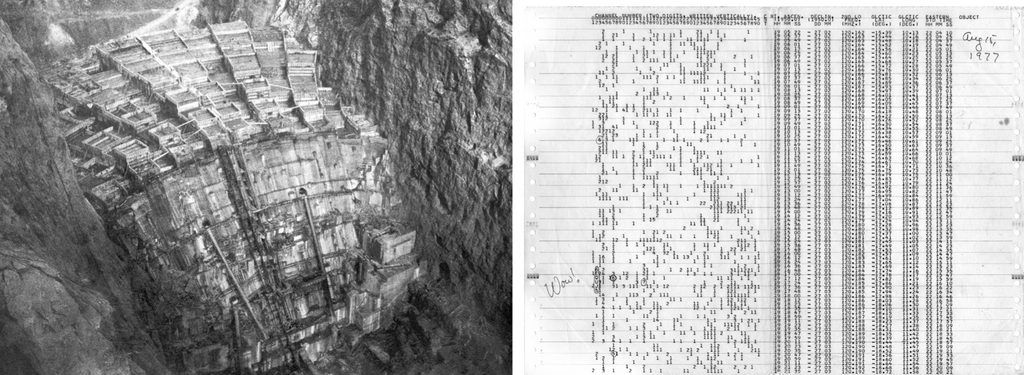
two gelatin silver prints
61 x 81.3 cm (each image size)
courtesy of the artist and Metro Pictures, New York
But why the anthrobscene? Why not just adapt to the normalized use of the anthropocene like geologists suggest?⁷ In short, the addition of the obscene is rather self-explaining when one starts to consider the unsustainable, politically dubious and ethically suspicious practices which maintain technological design culture and its corporate networks. Coltan’s relation to the bloody civil war in Congo and the use of child labour has been discussed now for some years in cultural theory. In media arts, pieces such as Tantalum Memorial (2008, by Harwood, Wright, Yokokoji) represent projects relating to the mineral politics of media. However, similarly we can remind ourselves of the environmentally disastrous consequences of planned obsolescence of electronic media, the energy costs of digital culture and for instance the neocolonial arrangements of material and energy extraction across the globe. Jennifer Gabrys is one of the inspiring writers who have pointed out the need to start from the other side – the electronic waste and the accident – in order to grasp the full picture of media cultural materiality. To call it anthrobscene is just to emphasize what we knew but perhaps shy away from acting on: a horrific human-caused drive towards a sixth mass extinction of species. To go underground is an analytical but also an ethico-aesthetic choice.
Design and cultural theorist Benjamin Bratton expresses the logistical movement of materials of technological culture when he writes: “billions of Earthlings everywhere carry little bits of Africa around with them in their pockets.”⁸ Among other materials, it is the metal tantalum mined from coltan in the Democratic Republic of Congo that moves across the planet as part of our electronics.
iPhones are, in the words of Mammoth, an architectural research and design platform, “geological extracts” drawing across the globe Earth resources and supported by a multiplicity of infrastructures. The bits of Earth you carry around are not restricted to small samples of Africa, but include the material from Red Dog pit mine in Alaska from where zinc ores are extracted, refined into indium in Trail, Canada. But that’s only a small part of it, and such sites where material turns gradually closer to media are “scattered across the globe in the aforementioned countries, as well as South Korea, Belgium, Russia, and Peru.”⁹ An analysis of dead media should also take into account this aspect of the earth, and its relation to global logistics and production.
Let’s focus for a while on China – but China understood as part of the global chains of production and abandonment of media technologies. In a sense, we can focus on the material production of what then ends up as the massive set of consumer gadgets, and the future fossil record for a robot media archaeologist, but also as discarded waste: both electronic waste and in general scrap metals, necessary for the booming urban architectural building projects and industrial growth. So much of this is driven by the entrepreneurial attitude of optimism; of seeing the world in terms of material and immaterial malleability, which in the case of media technologies has been recently realised also to include hardware in new ways. Indeed, in the midst of the wider enthusiasm for a global digital economy of software, some business correspondents like Jay Goldberg have realised that hardware is dirt cheap and even “dead.”¹⁰ His claim is less related to the Bruce Sterling-initiated proposal for a Handbook of Dead Media, “A naturalist’s field guide for the communications palaeontologist,”¹¹ than observing a business opportunity.
Goldberg’s dead media business-sense is focusing on the world of super cheap tablet computers he first encounters in China, then in the US for $40. For this particular story, it triggers a specific realisation regarding business models and hardware: the latter becomes discardable, opening a whole new world of opportunities.
“When I show this tablet to people in the industry, they have universally shared my shock. And then they always ask ‘Who made it?’ My stock answer is ‘Who cares?’ But the truth of it is that I do not know. There was no brand on the box or on the device. I have combed some of the internal documentation and cannot find an answer. This is how far the Shenzhen electronics complex has evolved. The hardware maker literally does not matter. Contract manufacturers can download a reference design from the chip maker and build to suit customer orders. If I had 20,000 friends and an easy way to import these into the US, I would put my own name on it and hand them out as business cards or Chanukah gifts.”¹²
The reduced price of the tablets means widespread availability even for specified niche uses: from waitresses to mechanics, elderly people to kids, tablets could become the necessary accessory in such visions that are blown away when realising the business prospects. The visceral reaction by Goldberg is followed by rational calculations of what it might mean in the context of digital economy business models:
“Once my heart started beating again, the first thing I thought was, ‘I thought the screen alone would cost more than $45.’ My next thought was, ‘This is really bad news for anyone who makes computing hardware. […] No one can make money selling hardware anymore. The only way to make money with hardware is to sell something else and get consumers to pay for the whole device and experience.’”¹³
Even hardware gets drawn into the discourse of experience economy with its connotations of immateriality. Hardware softens, becomes immaterialised and its materiality seems to change in our eyes. What Goldberg misses is that hardware does not die, not even in the Sterling sense of unused dead media that becomes a sedimented layer of fossils left for future media archaeologists to excavate. Remember Stoppani’s words from 1873. Instead, dead media and design products are abandoned, forgotten, stashed away and yet retain their toxic materiality that surpasses the usual time-scales we are used to in media studies. Such abandoned media devices are less about the time of use, or practices of users, but the time and practices of disuse. It would actually be interesting to write a history of cultural techniques of technological disuse. Besides such ideas, I want to give a reminder of the chemical durations of metal materiality. Think of this idea as the media technological equivalent of the half-life of nuclear material, calculated in hundreds and thousands of years of hazard; in media technological design, it refers to the dangerous materials inside screen and computing technologies that are a risk to scrap workers as well as nature, for instance soil. A pile of bad design – that is, design catered only for human users and their needs – will be the environmental afterglow of current gadget culture. This is a perspective on cultures of design that remain the legacy of the contemporary world for years, hundreds of years, thousands of years.
Professor Jussi Parikka is a Finnish media and art theorist who works at the Winchester School of Art, University of Southampton. He has worked on media archaeology, network culture and contemporary technological arts and design. His most recent book is A Geology of Media (2015) and his What is Media Archaeology? is currently being translated into Turkish. He is an invited participant at the Istanbul Design Biennial 2016, where with Ayhan Aytes he is exhibiting work related to the theme of media archaeology and speculative design of Middle-East automata and technology. More info: jussiparikka.net.
Notes
- Antonio Stoppani, “First Period of the Anthropozoic Era”. Trans. Valeria Federighi, edited by Etienne Turpin and Valeria Federighi. In Making the Geologic Now: Responses to the Material Conditions of Contemporary Life. Eds. Elizabeth Ellsworth and Jamie Kruse. New York: Punctum, 2013, p. 38.
- Sean Cubitt, “Electric Light and Energy”. Theory, Culture & Society, December 2013, vol. 30, no. 7–8, pp. 309–323.
- Historical Statistics for Mineral and Material Commodities in the United States. U.S. Geological Survey Data Series 140, minerals.usgs.gov/ds/2005/140/.
- Cf. Bruno Latour, An Inquiry into Modes of Existence: An Anthropology of the Moderns. Trans. Catherine Porter. Cambridge, MA: Harvard University Press, 2013, p. 10.
- Jennifer Gabrys, Digital Rubbish: A Natural History of Electronics. Ann Arbor: University of Michigan Press, 2011.
- See also Jussi Parikka, “Insects and Canaries: Medianatures and the Aesthetics of the Invisible”. Angelaki 18 (1), 2013, pp. 107–119.
- Sean Cubitt, Robert Hassan and Ingrid Volkmer, “Does Cloud Computing Have a Silver Lining?” Media, Culture & Society 2011, 33: 149–158.
- Benjamin Bratton, The Stack: On Software and Sovereignty. Cambridge, MA: The MIT Press, 2016, p. 82.
- Rob Holmes, “A Preliminary Atlas of Gizmo Landscapes”. Mammoth, April 1, 2010.
- Jay Goldberg, “Hardware is Dead”. VentureBeat, September 15, 2012.
- Bruce Sterling, “The Dead Media Project: A Modest Proposal and a Public Appeal”.
- Goldberg, “Hardware is Dead”.
- Ibid.