
Originally published in exhibist Print Issue 10 (October 2016).
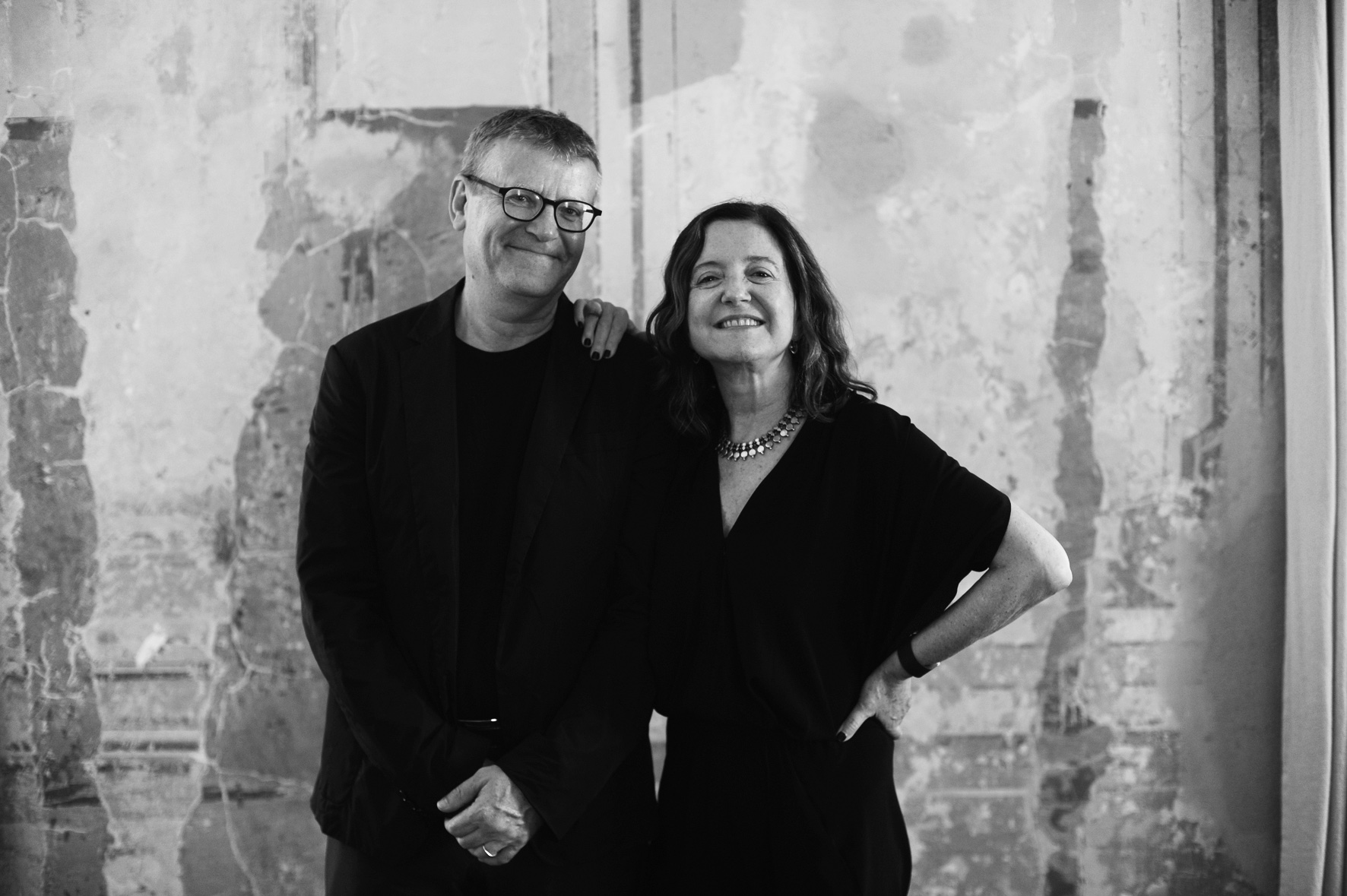
An interview with Beatriz Colomina and Mark Wigley, curators of the 3rd Istanbul Design Biennial, by Anna Zizlsperger.
Could you tell us about your project for the 3rd Istanbul Design Biennial? How did you come up with the title ‘ARE WE HUMAN? THE DESIGN OF THE SPECIES – 2 seconds, 2 days, 2 years, 200 years, 200,000 years’?
BC: I suppose the first thing to point out here is that this is not a typical design biennale, exhibiting the latest objects of the last two years in the field, which is the usual timeframe of a biennale. The first question we asked ourselves was “What is design?” and “What is a design biennale?” And what we realised is that design is actually much bigger than the role that is usually assigned to it in a biennale; that design is what defines the human, if you want to be dramatic about it. In that sense we were very dissatisfied with the typical two-year framework. We decided that we needed to go back to the beginning of the concept of design that we have today, which was 200 years ago. But actually we went back even further: to the beginning of humanity, which is about 200,000 years ago.
So from that point on we started thinking in terms of the power of ‘2’. You know – the two years of the biennale, the 200 years since the first debates that gave birth to what we understand as design today and the 200,000 years since the birth of humanity. Then we went back to the present and started thinking about how design today is happening in a very short amount of time for example in the two seconds of social media. That should give you a little bit of an idea of the temporal aspect of this biennale and our refusal of the two-year concept of a design biennale. We expanded the temporal dimension of what we are addressing. We don’t simply address the industrial design of beautiful lamps, but rather approach design as the beginning of humanity.
Can you talk a bit about the process of how you developed the concept – for example, where did you start?
MW: The main question we pose in this biennale, “Are we human?”, was something that came to our minds very early in the process. We always have a notebook with us and every time we read something or talk to someone, go for a meal, discuss something with a designer or read a book, we take notes. And it became clear relatively quickly that the really urgent question would be “Are we human?” I mean, if you keep your eyes open, it looks like our world is not so human. At the same time we think that this is the most ancient question of all. It is almost the question that defines our species, a species that is not sure about itself and speculates and thinks. And design is actually crucial to the way we speculate and think.
So it seems as if design might be much more important than designers think it is. Maybe one could even think that designers got left out somehow. This world we live in is now completely designed – everything from genetics to the weather and politics – just everything. And yet the design community is still making the same kind of beautiful objects. So we thought we had better radicalise it. But it was very important for us that we don’t provide the answer to the question. We asked as many people as possible to reflect. We didn’t ask them for answers. We talked to about 70 different architects, designers, archeologists, artists and scientists, and asked them to make a contribution in reaction to the question. Then we invited another 50 people to write about it for a project with e-flux. We just invited a lot of people to get together around this question. So in terms of method, all we were trying to do for a year was to find a way to frame the question that would somehow help people to liberate strong ideas.
BC: For us, a biennale is less an exhibition of objects or a trade show, and more of a philosophical enquiry. We believe that the role of a biennale is to ask questions – of the participants, of the public, and of ourselves, as the curators.
Can you tell us a bit about the key questions you came across in the process?
MW: Some questions which came to us very early were: “Why is it that we expect artists, writers and intellectuals to challenge us and make us think, while we ask designers just to give us the answer to a question?”; “Why do we want products from designers and ideas from artists?”; “Why is that the case and couldn’t it be the other way around?”; and “Couldn’t it be that art today has become a commodity and is very much determined by the market and is not really making us think so much anymore?”
And maybe design – precisely because it got left behind – now can be a source of reflection. It might be a good time to get together again and invent a new concept. But rather than delivering the concept, we just say “hey, let’s have a conversation about it.” And maybe that conversation needs to carry on for 10 or 20 years before something good comes out of it. But we had better start!
I would like to talk about the propositions, which are a central part of your concept: how did you develop them and what was your intention for them?
BC: I think that designers may very well be the victims of their own success. Because design is all around us now and everybody is interested in design at a superficial level. There is a design everything – a design store, designer clothes, design neighbourhoods, design hotels. And everybody thinks they know about it and they participate in this culture of design at whatever level – whether it’s high end Vitra or mass market IKEA. But what we are saying is that design is so much bigger than this kind of thin layer in which designers are concentrated that deals with lamps and chairs. And in that sense we have been left behind. Because the world is designed through much more complex things including our own genome or the weather. And designers have not become involved in that so far – they have remained stuck in this thin layer. So we are trying to encourage designers, in their minds and in their field, to engage in a much deeper and more philosophical enquiry.
MW: Of course, as teachers and historians, we see this biennale as a research project. We decided to write a manifesto with some of these thoughts and simply invite people to respond to it. That is why we wrote those eight propositions. Not so that people had to agree with them – maybe especially so that people could disagree or invent another proposition. So after about six months of thinking, we wrote the manifesto and then we spent the next six months trying to create the right garden in which people could really react to the manifesto.
What were people’s reactions?
MW: We had a great response. I mean it is fascinating – when you tell people about the theme and you say the title is “Are We Human?”, most people immediately interrupt you and give you their theory of the human. And then you say “The Design of the Species”, and they give you another theory. So it seems like people are really itching to talk about whether we are human or not. We are all very unsure if we are human at this point in world history. I think people are having incredible thoughts on this subject. And I don’t mean intellectuals and designers. Everybody is worried about this. In a way it is almost reason to be a bit hopeful!
You made an open call asking people to submit two-minute films in response to the theme of the biennial – what was the feedback you got?
MW: The response to the open call was completely amazing! It was maybe around 200 entries from about 37 different countries. And they were working very fast because the deadline was quite short. The jury was so impressed with the quality and the energy that they had to give more prominence to more of them than we first thought. All the submissions that complied with the rules, around 150, will be in the exhibition.
Would you say your biennial touches on politics and current topics?
MW: For sure; it is a very wide understanding of politics, though. It is not local. If you say politics is really about how we are going to live together on this planet, yes. Of course it applies to the situation in Turkey, but Turkey doesn’t have a monopoly on disaster. Anywhere in the world, you have to worry about how we are treating each other, all our companion species, and the planet itself. And anywhere in the world you cannot open your eyes or watch a screen or walk on the street without somehow being attacked by design. Injustice is everywhere and design is everywhere and they are interconnected. Not just in the sense that injustice itself is always designed but also that design is often the attempt to veil injustice. Design is often the design of blindness. That tends to mean you typically have two kinds of biennale. One that says we are just going to talk about the objects, and the other one that says that that’s not good enough and we have to talk about politics.
So you either get a beauty pageant of objects, or you get a self-righteous discussion in which a very small group of people believe that they have the best understanding of politics. And I would say these are two very boring kinds of exhibition. Because if design is really designing the human, then nothing could be more political than design. And a lot of what people would describe as a political conversation is really just a conversation about the aesthetics of politics. It is people who sound as if they are speaking about politics but maybe are not in the end.
So we would not claim to be experts on either side. We don’t claim to have some golden idea about design that is more special or more important than anyone else’s. And the last thing we would like to do is to say, for example, that we have some special insight into the situation in the Middle East. But somewhere in between the two there is a space in which the question of design is a biological, political and economic question. And if you take it seriously, then you already are right in the middle of politics, although not politics in the narrow sense. There is something quite romantic about the figure of the designer. It comes from the fact that almost every designer believes that society could be better – that the world could be better.
And almost every designer thinks that their work can contribute to that. Deep down, it may be one of the most optimistic fields there is. Maybe it is kind of naive – but it is arguably the last place in which people think we could do better. So we are also very interested in the dimension of politics that is not about naivety but about a commitment to some kind of better future – why not? This is why it was so exciting to work with so many people from this field. They really have that spirit. To say it the other way round: we think if you are serious about looking for a better society you have to be serious about design.
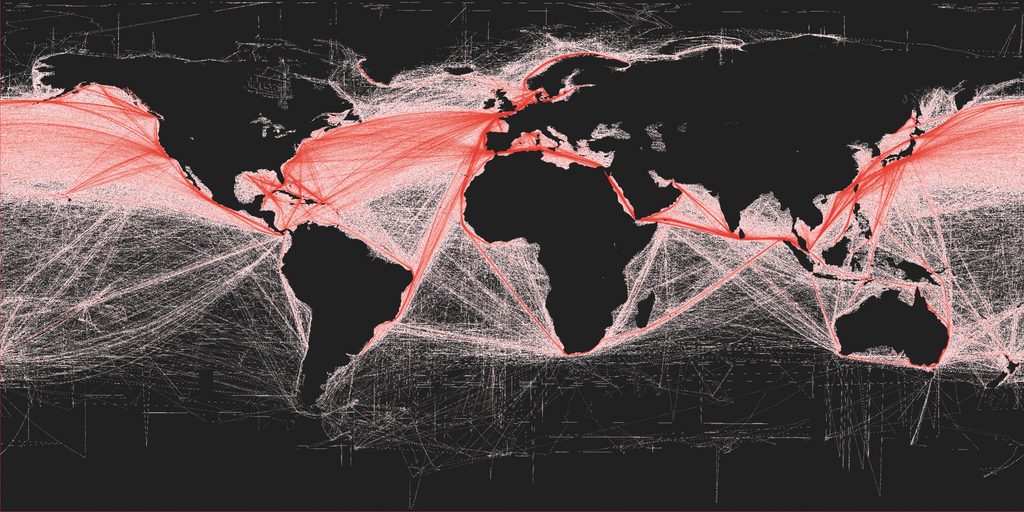
Study of the human impact on marine ecosystems, 2008 Source: B.S. Halpern
(T. Hengl; D. Groll) / Wikimedia Commons Courtesy İKSV
You say that everything around us is designed and everybody is designing the world around us. Could you elaborate on this statement in the context of the common understanding of the term design held by most people today?
BC: I think there is this narrow definition of design and of the design profession, which we discussed earlier. It goes back to industrialisation and the need to find ways to deal with the age of the machine. Before that, things were not designed by designers, but through a long process of time in which a bottle of wine for example would have been perfected in a collective effort. That was design too, but that was design that did not imply the name of a designer or of a school or of a set of ‘good design’ principles.
This idea of ‘good design’, which started with industrialisation about 200 years ago, may have reached its end. Because now we are also back to a situation in which everybody is a designer again. And not only because new technologies enable many more people to design things. This was actually one of the main subjects of the 1st Istanbul Design Biennale by Joseph Grima. Today, through social media, everybody from a little kid to a grandmother is designing themselves. They are participating in a design process. We think that if the industrial revolution birthed the question of design and the profession of the designer, then we are in an equally transformative moment.
With new forms of production and communication, we need a new definition of what design is. And we may need to go back to the beginning of humanity to understand that when we were designing the first shoes or the first boat, we were actually also transforming ourselves.
Would you say this is part of your theme and your biennial project, to renew the definition of the term both in the field and in the biennial?
BC: Yes. Right now, even politicians are talking about design thinking. And of course the industrialists depend on design: the most powerful companies in the world such as Apple and Samsung are heavily dependent on notions of design. And they are actually very much referring to Bauhaus ideas of design. I mean explicitly so in the case of Apple, right? So we should ask ourselves what it means, that we are still stuck with theories that emerged at such a different time in history.
MW: So we are interested in developing new theories of design. This means we actually don’t know what a designer is. I mean, if we knew what a designer was, we wouldn’t do the biennale. I think it would be really boring if we turned up in Istanbul with our ready-made theory of a designer. So we decided to treat this like an archeological show and said, “Let’s dig into design and see what it is.” As Beatriz puts it “how did we get here?” Maybe part of the problem with a typical biennale is that it shows you the products of the last two years. In the terms of the marketplace, that meant that the products would be accessible to the consumer a little bit later. So it acts as a sort of preview of the near future. It’s kind of a way for the marketplace to synchronise itself. Certain designers get awards and so on.
We said, let’s do the opposite: if you really want to see the future of design, look into the past and find out what design is – dig into it. And actually we asked all these different people just to dig into design, find out what it is. We treat design itself like an archeological object. People are lifting it up and brushing the dust off it and trying to understand what it is. And of course we have made some discoveries. We started to develop our own thinking about what design is, but don’t want to use the invited participants in the exhibition as examples of our thinking. We thought to put our thinking into a separate book as a set of notes. So we have written a book of field notes of what we now think after working for the last year and half in Istanbul called Are We Human? Notes on an Archaeology of Design.
We could answer your question in a few ways. One way would be to point to this book of notes and say “hey, actually we have a theory about this.” Or we could say “look at the exhibition.” But precisely we do not want to answer that question. We want the visitors themselves to do it – to think about whether the human is being designed and whether that’s what the human is: a kind of designing animal. In which case the most interesting piece of design and the most interesting designer in this exhibition would be the visitor. The visitors are the most amazing, intricate and complex design objects, and also the most interesting designers. Just to be alive, just to be human. So this exhibition tries to be a mirror to the visitors, so that they can see themselves in the extraordinary condition that is being a human.
I also read that you are trying to rethink the format of the biennial in terms of expanding its impact. One frequent criticism of biennials is that they claim to be relevant on a big scale but ultimately have a very temporary and localised impact. How is your concept different in this respect?
BC: We are not limited to the two-year project of the biennale. For example, Mark already talked about the e-flux collaboration with more than 50 philosophers, writers, architects, artists, etc. It is coming online in September, with a new dispatch posted every couple of days, and will remain active after the biennale is over. A book will also come out in 2017, so that is already an expansion of the idea of the biennale.
At the same time there is a team of about 50 experts in design from Turkey – historians, curators and philosophers from all kinds of different fields – who are putting together a Chronology of Design in Turkey over the last 200 years and building a research library that will be available to any designer and design historian in the future. This is a 10-year project that will become an archive. In the biennale we will have a number of exhibits related to this project, but the project will continue after the biennale is over. We are just providing the space for this first installment of the ‘History of Design in Turkey’.
Could you give us a preview of what we can expect at the design biennial? Is there any project that you would particularly like to talk about?
MW: Rather than talking about a single project, we would like to say a bit more about the feeling of the exhibition. Because the idea is that it will not be an exhibition of individual designers with their projects. The main idea is to have something like clouds of overlapping projects between which the visitor can make connections. We worked very closely with Andrés Jaque and his Office for Political Innovation in Madrid to create something like a garden that you walk through.
We also put together a team of students from Columbia and Princeton to work with us over the summer to prepare six major installations for the biennale. Design in 2 Seconds, for example, at the Bomonti venue, presents the new world of design in social media, with an interactive installation. We have another big installation at the Greek School, Homo Cellular, which is based on the idea that with the arrival of the cell phone we became a new, completely different species. There is another one called The Unstable Body, which is about the fact that every dimension of our body and brain is being redesigned. The others are called Are We Normal?, Design has gone Viral, and Enclosed by Mirrors. It’s a little bit unusual for a biennale to have the curators also make installations, but what we wanted for all venues was the feeling of a garden through which you walk. And every now and then you come across a very dense, research-based information blast, which might change how you move through the garden. That’s what we imagined.
Each of the venues has a different personality. The Studio-X is a laboratory in which all of the things you see are about designing new forms of life, whether they are biological, mechanical or electronic. And it’s based around these 13th century automata from the Islamic renaissance. It’s really amazing stuff, right down to the latest thinking in biology and ethics and computers. There is an exhibition being made by a young Turkish robotics designer. In fact the exhibition is being made by a robot. And even the designer who designed the robot doesn’t know what exhibition is going to look like. This is also going to happen at Studio-X. There will also be some amazing work on the Amazon, the Arctic, the Mediterranean, the refugees, the orangutan, prosthetics, and so on. It is really a kind of an encyclopedia of things. It’s really exciting to see the density and all the overlaps.
In previous statements about your biennial theme you talk about design having become the philosophical question of our time and that many major contemporary philosophers such as Latour, Sloterdijk and Žižek are engaged with it. Could you suggest some books to our readers to check out before visiting the biennale?
BC: Yes, it is crucial to note that the leading minds of our time are turning to the question of design. But this doesn’t mean we should all read these thinkers. It means we should read design! In this context I would refer your readers to our venue at Studio-X. The group of 50 or so people, who now call themselves ‘Curious Assembly’ making that new kind of chronological archive of design in Turkey over the last 200 years are assembling a really interesting library. Even after the biennale, people can go to Studio-X and use the library. For us personally, there have been so many books that have been important.
We have our own huge ever growing collection of books on design and the human and have read an enormous amount this year. But there is not one single book we would recommend over the others. As we were saying before, Mark and I have written a book that will be published on the occasion of the opening of the biennale entitled Are We Human? Notes on an Archaeology of Design, and it is precisely that. It is field notes of all the thoughts we have had during the process of organising the biennale. The book can be seen as a guide to our thinking, but not necessarily as a guide to the biennale.
MW: I think if you asked us a year ago which books we would recommend, we would have said “Nothing – all these books are boring. There are millions of books about design and they are totally boring.” And then about six months later we would have given you a list of books that we were really excited about. And at this point now, we have too many favourites. In a way, the idea of the exhibition is to start a conversation that will ultimately produce a new kind of book. I think we will only know if it is a good exhibition five years from now. We will see if somehow some kind of conversation has developed. The really important part of the work is not what people will see in the room but what they might see in other rooms or read later.
Rather than recommending a book one should read before going, I would recommend a book you can read five years from now. And hopefully in the exhibition you can sort of sense the emergence of something, but it will not be coming from us. We are finished. We have finished our book already. It’s the new work that is so very important. People are always asking us why we are doing this in Istanbul. We always had the feeling that you could have a conversation in Istanbul that’s not possible in the so-called ‘design capitals’. And anyway, what do they mean by ‘design capitals’? In Istanbul you dig a hole and you find another civilisation. That’s a design capital if there ever was one!
BC: At the same time I think we have to acknowledge that the situation is not easy right now in Turkey, to say the least. But we feel that particularly now it is so important to continue.
MW: The question “Are We Human?” is driven by the shared disaster that we are all living in. So the difficulties only make it more urgent to discuss design. For us design is not a luxury conversation that you only have when everybody is happy. And a beautiful object is not something that’s made because the person who made it is happy or safe. Maybe the most beautiful or most important object is made because the person is not sure and not safe. And believe me those of us listening to the presidential discussions in the United States do not feel safe. Again, Turkey doesn’t have the monopoly on insecurity. For us, design is exactly the conversation that must happen. Not the conversation that you do on the weekend or when you’re feeling good. It’s urgent, always.