
Originally published in exhibist Print Issue 3 (May 2014).
An interview with Banu Cennetoğlu, artist and founder of BAS, by Anna Zizlsperger.
As both a practicing artist and founder of the BAS project space in Istanbul, can you tell us more about your work and this significant venture?
When I look back at my last three to four years of practice, quite formally and roughly put I have been persistently compiling, sorting, arranging, classifying, editing, rearranging, re-editing, displaying, and in between occasionally recording… Departing mostly from site-specific configurations and questions, I am interested in those rigid but fragile extracts that might potentially generate more than the messy ‘allness.’ Speaking of messiness, I am not able to produce as an immediate reaction; I can do a lot as an immediate reaction but not art. So cooling, delay and distance are vital.
During the past few years, the medium has become quite variable and the collaborations more frequent. Volumes of Cypriot and Arabic newspapers all dated the same day, a hand-blown glass sex toy containing 25 grams of dust from an army barrack in Murcia¹, books and photographs and free offers, a video recording of an energy scan of a nuclear bunker², a library of home-made spirits… and then there are irregular regularities such as The List³ and BAS.
If I go back further, from 1999 onwards I have been working intensively with and have been interested in the capacity of images, particularly when my intention and research were trying to depict, if I may call it thus, the political uncertainty. This might sound cryptic, but I was interested as well in that crypticism up to a certain extent since that possible ambiguity or tension could maybe be the strength of the kind of photography that interested me. For many years I extensively photographed a very specific condition or conditions and then interfered with the compilation using other images collected from other situations.
As I was interested in the constructed or forced coexistence of those images as a sequence rather than an edited wall display, the book space became relevant and liberating for me. So I started to work with it in 1998 with dark room prints and Xeroxes and then eventually became more interested in the potentiality of printed matter as an autonomous artwork, then multiple editions, and exhibitions as a channel of distribution and circulation and as a value system, etc.
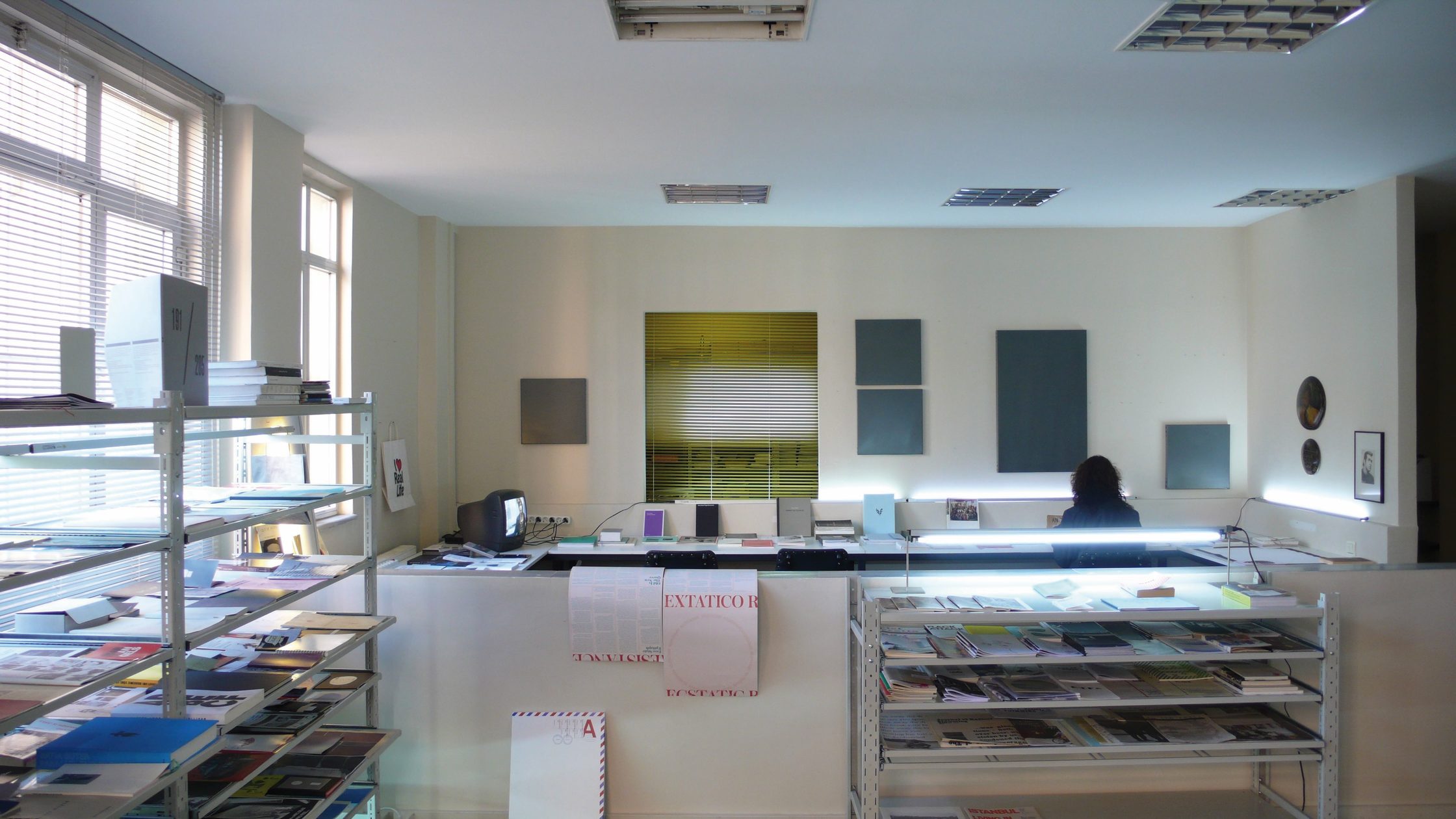
When I returned to Istanbul in 2005 after a decade abroad, I wanted to have a space where I could share and display my small compilation of book-works and printed matter collected mostly from friends between 1998–2005. I was also in need of a studio space: a table. So based on available resources and offers from friends, I installed the books and myself in a 25 square meter storefront in Şişhane during the fall of 2005. And this became BAS.
Since then we have moved twice and are currently located on Necati Bey Caddesi, No 32, Karaköy. The collection grew. Between 2006–2009, BAS published Bent, a series of artists’ books from Turkey co-edited by Philippine Hoegen and myself. We hosted several archival exhibitions and talks and participated with our titles at exhibitions and international art book fairs. In addition to Bent, BAS published An Interrupted History of Punk and Underground Resources in Turkey 1978–1999 edited by Sezgin Boynik and Tolga Güldallı. In terms of distribution, the titles are slowly but surely expanding to several national and international libraries, collections and bookstores.
BAS has a consistent inconsistency. Sustainability and continuity are constant issues, not only financially but also in terms of temporal and spatial relevancy… Yes, we have generous volunteers and supporters and without them we could not exist, but still as an artist-run space, it is highly dependent on my time and energy, so it is a double-edged sword.
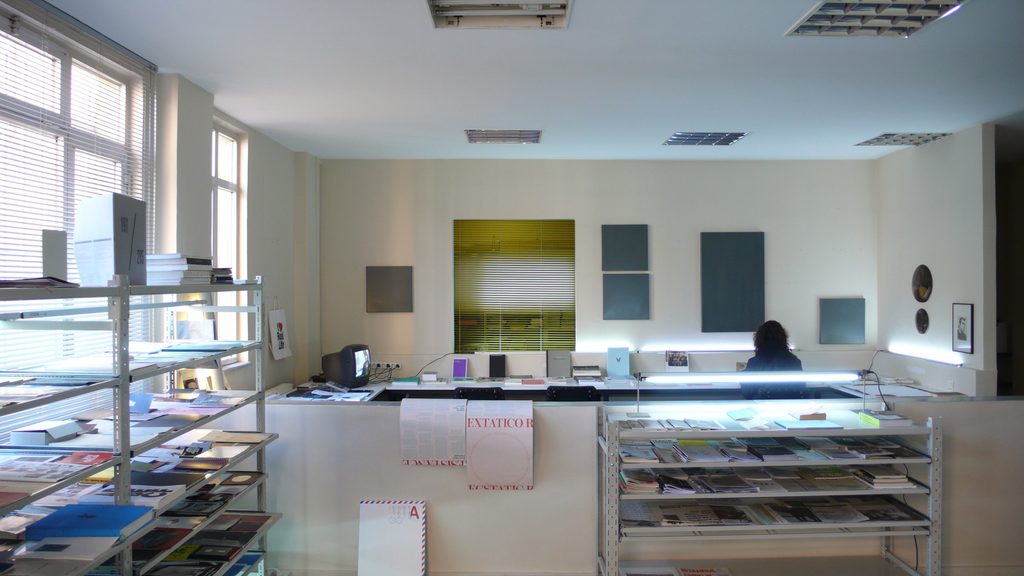
courtesy of BAS
How did you go about acquiring your theoretical art knowledge? Who or what were your personal inspirations?
I studied psychology, so my theoretical knowledge was not related to art. Back then, already interested in image making, I got a scholarship to study photography at a small institution in Paris where the theory input was intense but came in small doses… Then I moved to New York in 1996 and worked as a professional photographer for a few years where I started to meet/read works from Semiotexte, Kathy Acker, Chris Marker, Barthes, Sontag, Richard Foreman, Edward Tufte – and anything at Printed Matter was a great source of knowledge. At the end of 2001 I completely quit photographic commissions and moved to Amsterdam to participate in a 2-year research programme at the Rijksakademie.
That was my luxurious era. The first six months I practically relocated the majority of Rijks’ library to my studio. Amongst many others, Agamben was / is very relevant since I was working on issues like transition, suspension and displacement. I also loved Jean-Luc Nancy, but only within the limits of whatever I could grasp. Rijksakademie was also good in terms of having discussions since intense theory could easily have a blocking effect if solely ingested.
Also back then in Amsterdam, discussions about the doctorate in arts were just beginning, but they were exciting. It was a few years after the Bologna declaration; Rijksakademie had an autonomous status and wanted to stay as such. Although I did not want to pursue a PhD programme, it was very useful to be part of these discussions, especially when one gets a great kick from words and this kick might end up smashing the piece.
What is your opinion on the role of academics in the field of contemporary art in Turkey?
I did not study art here and I don’t have a full-time teaching position, so my answer is quite general. Education in Turkey is difficult and full of black holes. The darkness starts from very early stages. Higher education and particularly art education has even more issues compared to some other disciplines. There is a monster called YÖK (Higher Education Institute). With very few exceptions, the private universities don’t offer much. Mimar Sinan is exhausted and full of issues. There is also a huge lack of communication and collaboration across departments and between disciplines. So in my opinion we cannot talk about a sufficient, generous, productive and interesting exchange between academia and contemporary art. But of course there are several individuals out there doing great work. I don’t know how to make those academic walls more transparent and halls more welcoming, but one possibility could be creating outside-inside hubs to increase participation by sharing and exchanging knowledge more informally and somehow blurring the borders…
Do you feel Turkey is adequately represented in the international academic art scene? Which, if any, academics do you think have most influenced the scene?
Being an artist or a practitioner in art and working in academia/teaching and relating your practice to your research is obviously super-demanding, but when it works for all the parties it can be very good. Although people might have the good work and the good will, the system here is not keen to embrace the different… This has become even more extreme during the last ten years. So it is very much up to the individual to subvert the situation.
I don’t feel competent commenting on your question of whether they are adequately represented, but just to name a few because you asked (they do not necessarily all come from art and do not all teach regularly or full time, and sadly some are not around anymore): I like the work of Erden Kosova, Cevdet Erek, Yahya Madra, Bülent Tanju, Esen Karol, Pelin Tan, Didem Pekün, İnci Eviner, Başak Şenova, Zafer Aracagök, Bülent Diken, Sibel Yardımcı, Burcu Dündar, Süreyyya Evren, Aras Özgün, Ulus Baker…
Which materials would you suggest students in Turkey read in the fields of fine art and art theory? Conversely, what do you think non-natives could read to get a better theoretical insight into the country’s current art scene?
I prefer not to make suggestions strictly limited to art and theory, but here are some from the local context:
Kitap Nesnesi Nesne Olarak Kitap by Burcu Dündar (Book Object Book As Object, Akın Nalça, 2012); Sanatta Alternatif Arayışlar by Nancy Atakan (Alternative Approaches In Art, Karakalem Kitabevi, Art Series, 2009); Mütevazı Bir Miras by Nilgün Özayten (A Modest Heritage, e-publication, Make a Book, SALT); Szene Türkei: Abseits, Aber Tor by Vasıf Kortun and Erden Kosova (The Scene in Turkey: Offside, But A Goal, Walther König, 2004); www.red-thread.org [English/Turkish e-journal published between 2009 and 2011]; m-est.org [English online publication focusing on artists from Turkey founded in 2011]; www.surplusthought.net/ymadra [collection of links for Turkish/English scholarly texts, videos, and images by Yahya Mete Madra, Associate Professor of Economics, Boğaziçi University, Istanbul]; www.e-skop.com [Turkish online magazine featuring critical writings and reviews of exhibitions, theses and books founded in 2010]; www.saltonline.org/tr/makeabook [e-publishing platform by SALT where readers are able to select chapters from different e-books and construct a personalized book]; guncelsanattaemek.wordpress.com [research project with an online platform aiming to capture the various forms of labor arising in different kinds/modes of contemporary art and its institutions].
And I would suggest BAS; we have a lot of good stuff!
I’ve heard that the art education in Turkey is still rather traditional, with the focus being more on developing the craft rather than on theory. Do you feel this is the case? How are things changing or developing?
I think the main problem is lack of critical thinking on why one does what she / he does… You need craftsmanship, you need theory, but first you have to learn how to question and how to articulate your questions. And this is relevant for the entirety of our education system. Also, the way history is written in this land in several fields, including art, is very fragmented and full of gaps. Language is a whole other issue… Not only for Western languages, but we live in a geography where we have no access to lots of material since we are not able to read several other alphabets which were and still are part of this culture… And finally, theory in art is important, but this also depends on what you read and what you do with what you read. Also too much theory in artistic practice can be oddly comfortable to be wrapped in and thus trapped by…
Soon enough, particularly at a few institutions, the discussion of a practice-based PhD programme will be a more often-discussed topic. Although I have mixed feelings about it, I am interested in seeing discussions developing around it, which can possibly be productive in overcoming the gap between art and critical theory – though not necessarily art theory – and this can help enlarge the framework in which we position works and art practice.
From your perspective, what would you say is the most important lesson for students to learn as aspiring artists?
I think it’s a question of ‘What do you do with what you see and accumulate?’ Having a discursive context has great importance and this doesn’t have to be academic or come from academia. Maybe the most difficult thing here is to listen, to talk and discuss simply and sincerely without creating drama. This might sound corny, but trying to learn from others and sharing what you have without comparing yourself to them can be very useful. Also I highly suggest keeping a distance from the myth of being an artist so that egos can be slightly adjusted. Recently, I’ve become more optimistic about young people and their way of being and coexisting – they’re way less judgmental than us, well at least than myself.
You’ve lived, worked and studied in Paris, Amsterdam and New York. Do you think it is advisable for art students from Turkey to go abroad, if possible, to further their education?
If they can, yes, sure – travelling or living abroad is always enriching, but today’s situation is obviously different than that of the 90s… You can get and do a lot even from your local park! Also, one does not necessarily have to go to Paris, London, or Berlin. Whomever we are neighbors with is also important to witness and to be part of…
How would you say living abroad has changed your own personal way of thinking and your artistic practice?
My journey was fully improvised, at least to start with. I only had the means to go for a month and ended up with 11 years abroad. I have moved and moved following a kind of urgency that I can’t really describe, but it was a gut call… I have an unusual notion of attachment and detachment, which can sometimes be very visible through my practice. I was and still am always eager to learn and research, but I have never felt comfortable with selections, applications and academic hierarchy; Rijksakademie was my only application adventure. I believe in hybrid and non-standardized models, which can liberate one from comforting familiarities but of course come along with an unavoidable, sweet and severe solitude…
You left Turkey in your early 20s and returned in 2005. What made you come back and what can you tell us about how the local art scene has changed since the 90s?
For 11 years all my training and practice were outside of Turkey, so all I know about the 90s comes from what I’ve heard, read or been told by those who experienced the period. It was a time of genuinely political and quite radical production. After the second half of the 90s and beginning of 2000s, this mode of production assumed a different face with a certain concern for visibility, and the attention from the West started to nourish certain tendencies. There is a whole series of large regional exhibitions that took place in Europe, which had an important impact on local positions and productions and generated some standardization. Some subjects were in demand and were in themselves enough of a reason to be a part of some shows, independent of the quality of the artist or of the work. But some changes are finally happening.
When I was at Rijksakademie in 2002, I could see this happening, and honestly I was quite anxious to come back but also to stay there. I ended up coming back because I had to come back. Not having enough resources, not having a visa, not willing to go back to New York – Bush being in America – not wanting to stay in the Netherlands just for potential subsidies, combined with a family emergency around that time…
What are your thoughts about the current situation in Turkey and how do you see the future of Turkey’s contemporary art scene? How would you say censorship has affected it as a whole?
The situation in Turkey has been fragile and intense and interesting since last May. Censorship has a dark and shameful legacy in this country, and more nasty measures are on the way. We also have a sinful past and present in human rights. So I can’t think of the art scene/practice independently from the entirety of the situation. We have to reinvent (and in some cases just invent) new modes of practice because they’ve never existed. And when I say practice, I don’t only mean artistic practice. If we can get organized, do this without turning it into a spectacle or creating heroes, but truly owning up to it, each and every one of us, doing whatever we can do… it will no doubt affect artistic production as well. There is urgency for organized solidarity and resistance and not only when there is a momentary emergency. This urgency has to be consistent so that it can lead to an ordinary, everyday awareness and readiness to act.
You have been publishing artist books under the label Bent since 2006. Can you tell us about your most recent publication and what you have in store for the future?
To support a local production and generate a discussion on the medium of printed materials, Bent deliberately focused on collaborations with artists from Turkey. We realized titles by four artists and one artist collective. After Philippine (Hoegen) moved to Brussels in 2011, we decided to stop the production of the Bent series, though projects that resulted from, or relate to, Bent still continue.
Daniel Knorr Sanatçı Kitabı (Artist’s Book) is the first book of the post-Bent production period. It is the eighth edition in a series of artists’ books by Daniel Knorr called Carte De Artiste, which he started in Romania in 2007. Value-free objects and trash are collected in public spaces by the artist and inserted between the pages of an empty book, which has been prepared to host the compilation. Then they are pressed flat with an industrial 30-ton press. Each edition is made in a different country and has the same size, the same name and the same edition number of 200 unique copies. Aiming to create a global encyclopedia, the series includes editions from Romania, China, Ireland, Switzerland, New Zealand, Sweden and Armenia. Each book contains a DVD with a film made especially for that particular edition, which documents the process of making the work.
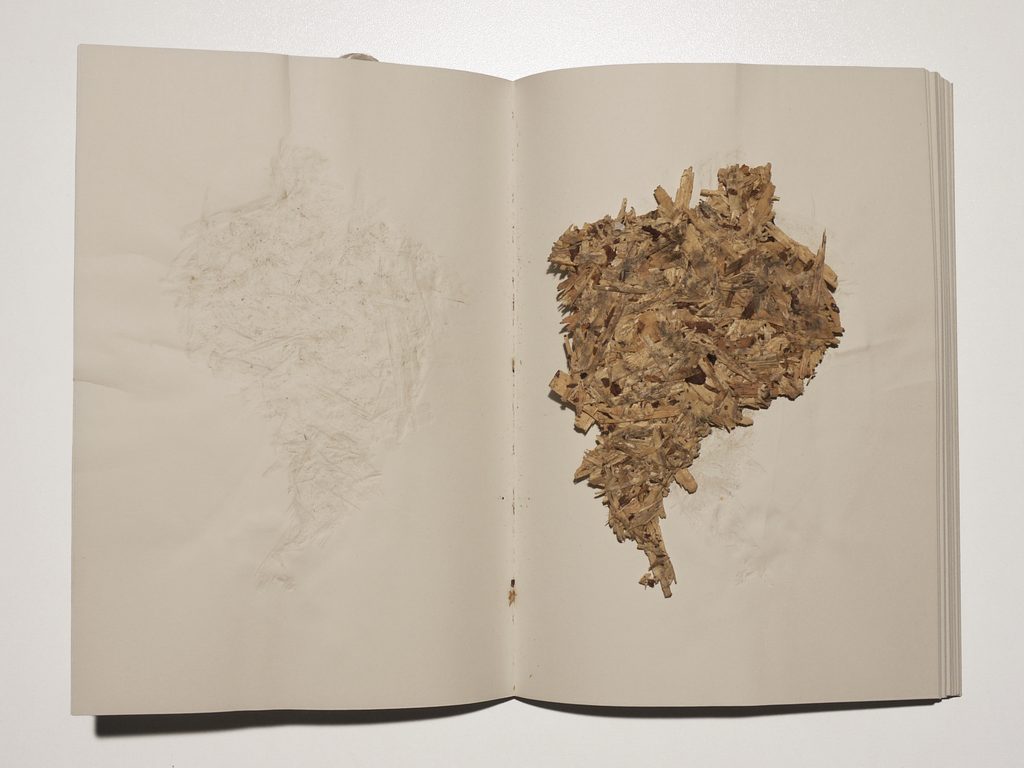
value-free objects and trash pressed between the pages of an empty book with an industrial 30-ton press courtesy of the artist & BAS
And currently in process as a major and generous collaboration with Collectorspace, we are working on the local edition of Corrections and Clarifications by Anita Di Bianco. The work is an ongoing newspaper project that has been produced in various locations, languages, and formats since 2001. Each iteration of the work is an edited compilation of corrections of typographical or factual mistakes, as well as statements intended to clear up misinformation published in daily newspapers. So hopefully we will have our own ‘local’ Corrections and Clarifications.
Do you have any personal future projects in the works?
I am currently working on the second episode of the library of spirits. The idea for the first episode started and was realised in Romania, but it could start and continue almost anywhere in the world. It is about compiling a selection of homemade non-commercialized spirits. The vapor given off and collected during an alchemical process was called a ‘spirit’ of the original material, and apparently this original material could be almost anything… it goes back to the 1st century AD, to Greek alchemists, to Medieval Arabs and then to the School of Salerno, to Southern Italy in the 12th century, and then to China – the Southern Song Dynasty, and so on and so forth.
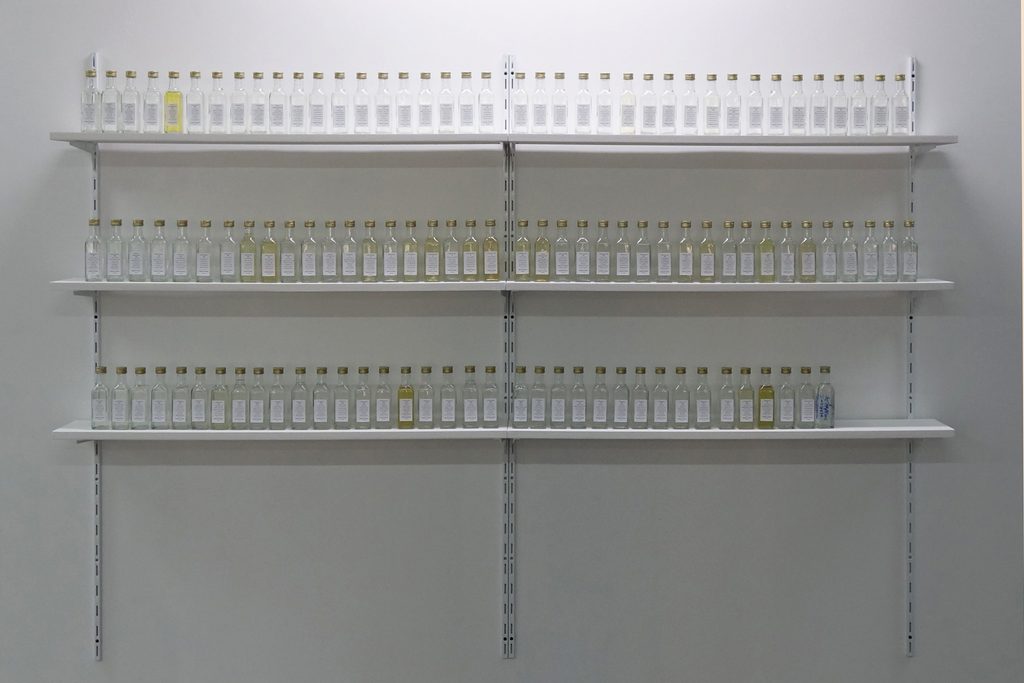
The installation at Salonul de Proiecte in Bucharest consisted of a 12-meter-long open BAR, BanuBarMixt, where the audience could try 155 kinds of local spirits kept in their original receptacles. The BAR was open to the public during the entire period of exhibition. Before we opened the bar to the public, we took 300 ml of each spirit to make three editions of 100 ml glass bottles. This compilation became part of the library. Each bottle has a label that tells when, where and by whom its contents were produced and when and where we got it, the times of distillation, production partner, amount, edition number and country of collection, as well as the ‘contact spirit,’ which is the inspiration, the reason we go to that particular location and try to get a sample. A contact spirit can be the grandmother of a guard who works at a museum or Tristan Tzara or Nadia Comăneci or the stray dogs of Transylvania.
The bar is a local site-specific situation and doesn’t travel. The compiled extracts do travel. So the next episode will be from South Korea and exhibited at the Gwangju Biennial in September. To be continued…
photo courtesy of the artist
Notes:
- For the commissioned piece by Manifesta 8, The European Biennial of Contemporary Art (region of Murcia, Spain, in dialogue with northern Africa), Banu Cennetoğlu collaborated with London-based designer Shiri Zinn. One of Zinn’s ‘limited edition glass toys’ has been customized to become a cremation urn carrying a sample of dust collected from the exhibition site Pavillon II, the former artillery barracks in Murcia.
- What is it that you are worried about? Single channel HD video, 35’, 2013. In this collaborative project, Banu Cennetoğlu and Yasemin Özcan seek the assistance of a non-artistic discipline to measure the energies circulating in the physical space of Facility D-0, Tito’s Atomic War Command, aka ARK. The object is put through a holographic energy scan by Habitat and Human Energy Rebalancing coach Zeynep Sevil Güven. For this specific project, Güven simultaneously uses the Inner-Speak protocol and her self-developed ZSG healing method to reveal the invisible data of this very space, which she approaches through the architectural plan of the bunker so as to achieve a deep cleansing.
- The List is a document that contains the names of more than 16,264 known refugees and asylum seekers who have died within, or on the borders of, Europe since 1993 (www.the-list.info).